
Sourcing kitchen tools and utensils can look simple on paper. The differences often show up in the samples: two spatulas may share a shape but use different materials, cores, handle joints, finishes, or packaging. For importers, a kitchen tools and utensils sourcing guide is useful when it helps keep the product specification, compliance evidence, approved sample, and purchase order aligned.
This guide is for importers, retailers, wholesalers, and ecommerce brands buying non-powered tools such as spatulas, tongs, whisks, ladles, peelers, graters, and cutting boards. Cookware has different construction and inspection requirements. Decide whether you are buying one lead SKU or a coordinated set before asking factories to quote.
Points clés à retenir
- Specify every component, intended use, dimensions, finish, packaging, target market, and quantity before requesting prices.
- Check supplier identity and production capability separately; listings and certificates are only starting points.
- Ask for food-contact evidence that matches the final SKU and destination market, then approve a sample against written criteria.
- Compare landed cost and commercial terms, not unit price alone.
Which kitchen tools and utensils should you source first?
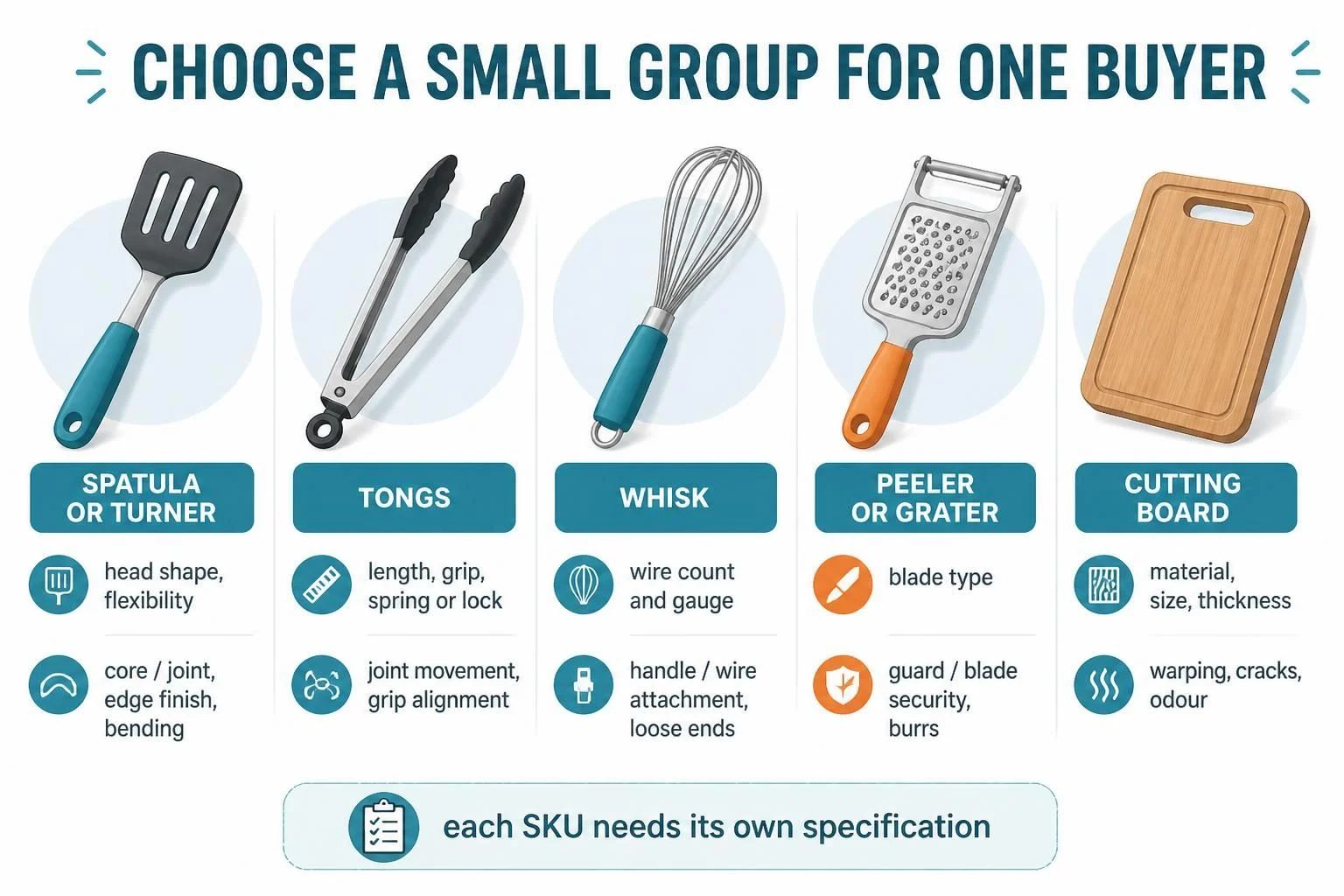
Choose a small group of products for the same buyer and sales channel. A prep set might include a turner, ladle, whisk, and tongs, but each SKU still needs its own material, dimensions, function, and packaging specification. Use your sales history, customer research, and channel requirements to decide which items belong in the range.
Specify each tool around its use and likely failure points. A spatula may flex against a hot pan; tongs depend on the joint and grip; a peeler needs a secure blade and protective packaging. For a cutting board, define dimensions, edge finish, and cleaning instructions. Record the relevant checks in the product brief.
| Produit | Définir dans le bref | Inspectez attentivement |
|---|---|---|
| Spatula or turner | Head shape, flexibility, core, handle, use conditions | Joint, edge finish, bending, surface defects |
| Pinces | Length, grip shape, spring or locking design, material | Joint movement, lock, grip alignment, sharp edges |
| Fouet | Wire count/gauge, handle, overall length, use | Wire attachment, loose ends, handle strength |
| Peeler or grater | Blade type, handle, guard, package protection | Blade security, burrs, sharp-part protection |
| Planche à découper | Material, size, thickness, texture, edge and color | Warping, cracks, finish, odor, pack protection |
A set adds coordination work. List the included items, confirm whether colors must match, and show how the pieces should sit in the retail box. Note any insert or printed instructions in the packaging brief. For broader category options, see ustensiles de cuisine en gros.
Which materials and construction details belong in the specification?
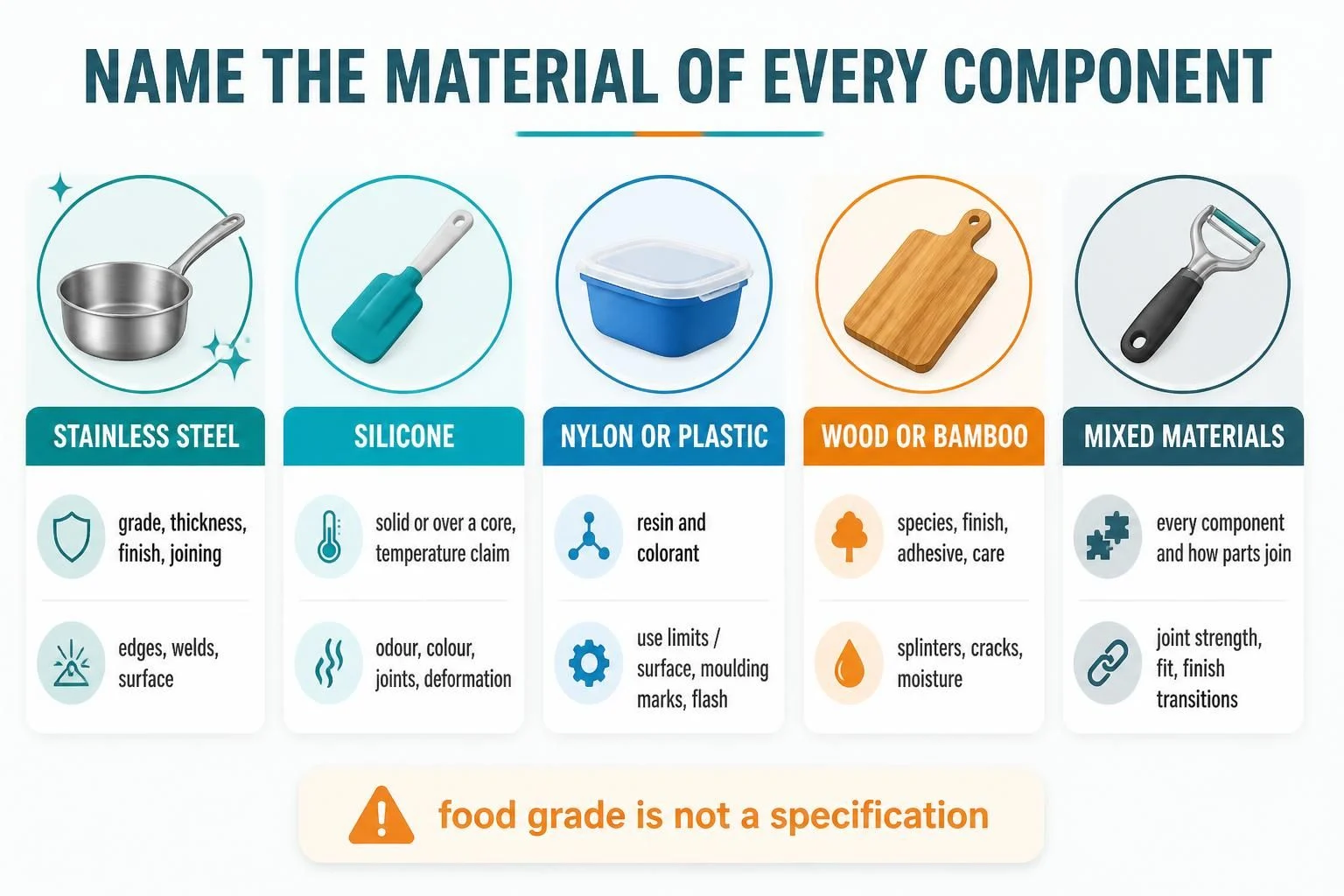
Name the material of every component that may contact food, heat, water, or a user’s hand. “Food grade” does not tell a factory which polymer, alloy, coating, or construction to quote. Requirements depend on the product’s intended use and destination market, so record both before requesting documents or testing.
Stainless-steel tools need a specified grade where the application requires one, along with dimensions, thickness, finish, handle construction, and edge requirements. Silicone tools may have a solid body or a separate core and handle. Plastic tools need the specific resin and colorant details relevant to the product. Wood and bamboo products need dimensions, surface finish, adhesive or coating information where applicable, and care instructions. Mixed-material designs need all of these details by component.
| Matériaux ou construction | Questions pour le fournisseur | Chèques de l'acheteur |
|---|---|---|
| Inox | What grade, thickness, finish, and joining method are used? | Edges, welds, surface finish, dimensions |
| Silicone | Is it solid or over a core? What use and temperature claim is supported? | Odor, color consistency, joints, deformation against agreed criteria |
| Nylon or other plastic | Which resin and colorant? What use limitations apply? | Surface, molding marks, flash, dimensions, labeling |
| Bois ou bambou | What species/material, finish, adhesive, and care instruction apply? | Splinters, cracks, finish coverage, moisture-related defects |
| Matériaux mélangés | What is each component made from, and how are parts joined? | Joint strength, fit, finish transitions, evidence by material |
“Silicone spatula” names a product family, not a production specification. The core, silicone body, hardness, dimensions, color, handle attachment, use claim, and packaging all affect the finished item. Ask suppliers to list proposed substitutions separately, and keep the approved detail sheet with the purchase order.
For products that contact food, check the material and intended use against the rules in the destination market. The US FDA explains its framework for substances en contact avec les aliments. In the EU, Le règlement (CE) n 1935 / 2004 provides a framework for materials and articles intended to contact food; additional rules apply to some material groups. Have a qualified adviser confirm the current requirements for the product.
How do you find and screen kitchen utensil suppliers?
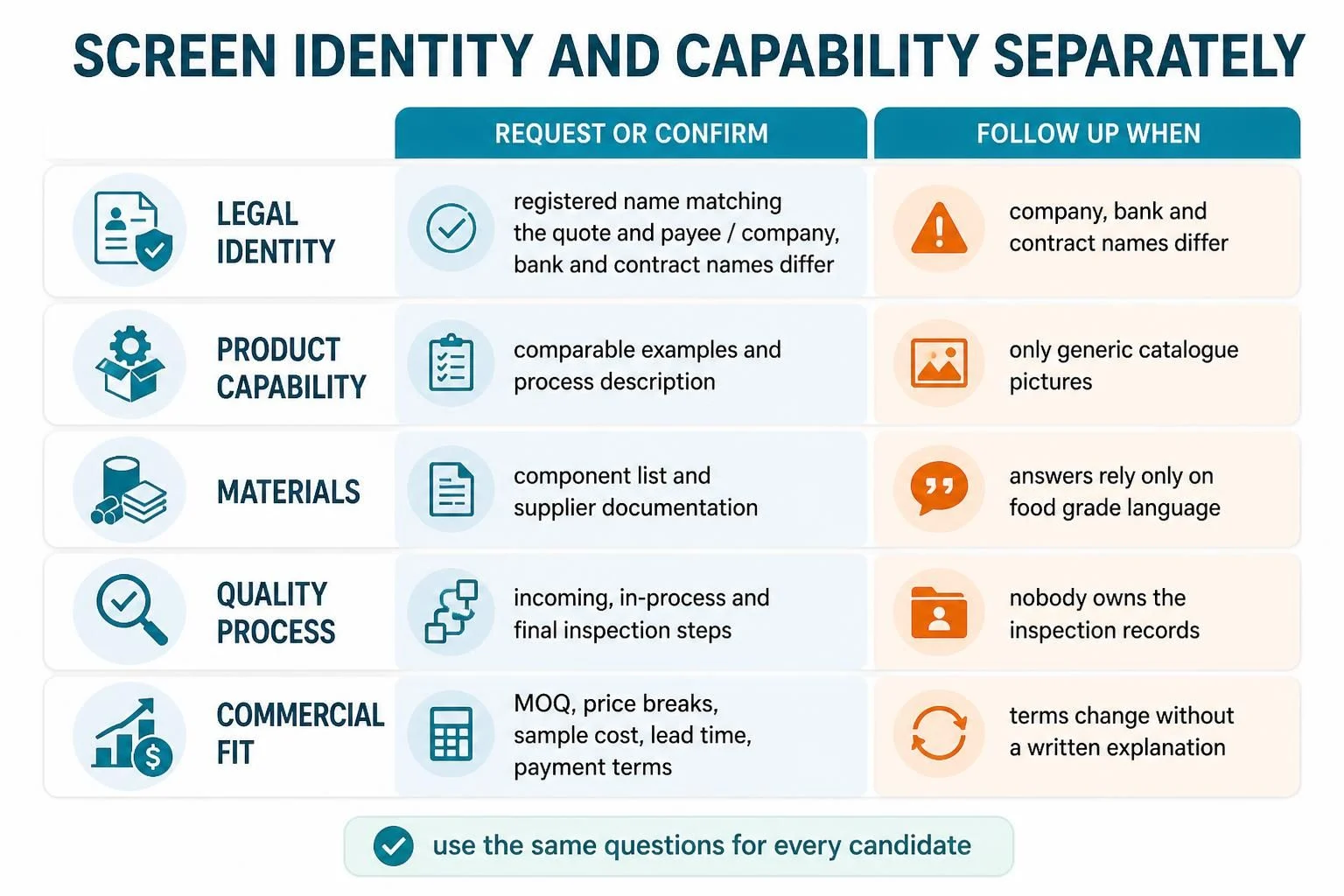
Build a shortlist through marketplaces, trade fairs, referrals, or a service de recherche de produits. Then check each candidate’s identity and capability. A marketplace badge or catalogue does not establish who will make your order. Match the registered business name across company records, the quotation, contract, and payment instructions.
Ask whether the supplier is a factory or trading company, and which production steps it handles. Molding, stamping, polishing, assembly, printing, and packing may take place at different workshops. Outsourcing is easier to assess when the supplier discloses it and explains who controls material purchasing, production records, inspections, and corrective actions.
| Zone de projection | Request or confirm | Assurez un suivi lorsque |
|---|---|---|
| Identité juridique | Registered name and details matching quote and payee | Company, bank, and contract names differ |
| Capacité du produit | Comparable product examples and process description | Only generic catalogue pictures are supplied |
| Matériel Requis | Component list and supplier material documentation | Answers rely only on “food grade” language |
| Processus qualité | Incoming, in-process, and final inspection steps | No one owns inspection records or corrective action |
| Convient aux professionnels | MOQ, price breaks, sample cost, lead time, payment terms | Terms change without a written explanation |
Use the same questions for each candidate, then record the answers in a shortlist. The guide to vérifier 1688 fournisseurs has a useful document and payment checklist; apply the same discipline to suppliers found elsewhere. Keep a record of the evidence reviewed and any gaps that still need an answer before approving the supplier.
What should a kitchen tools and utensils RFQ include?
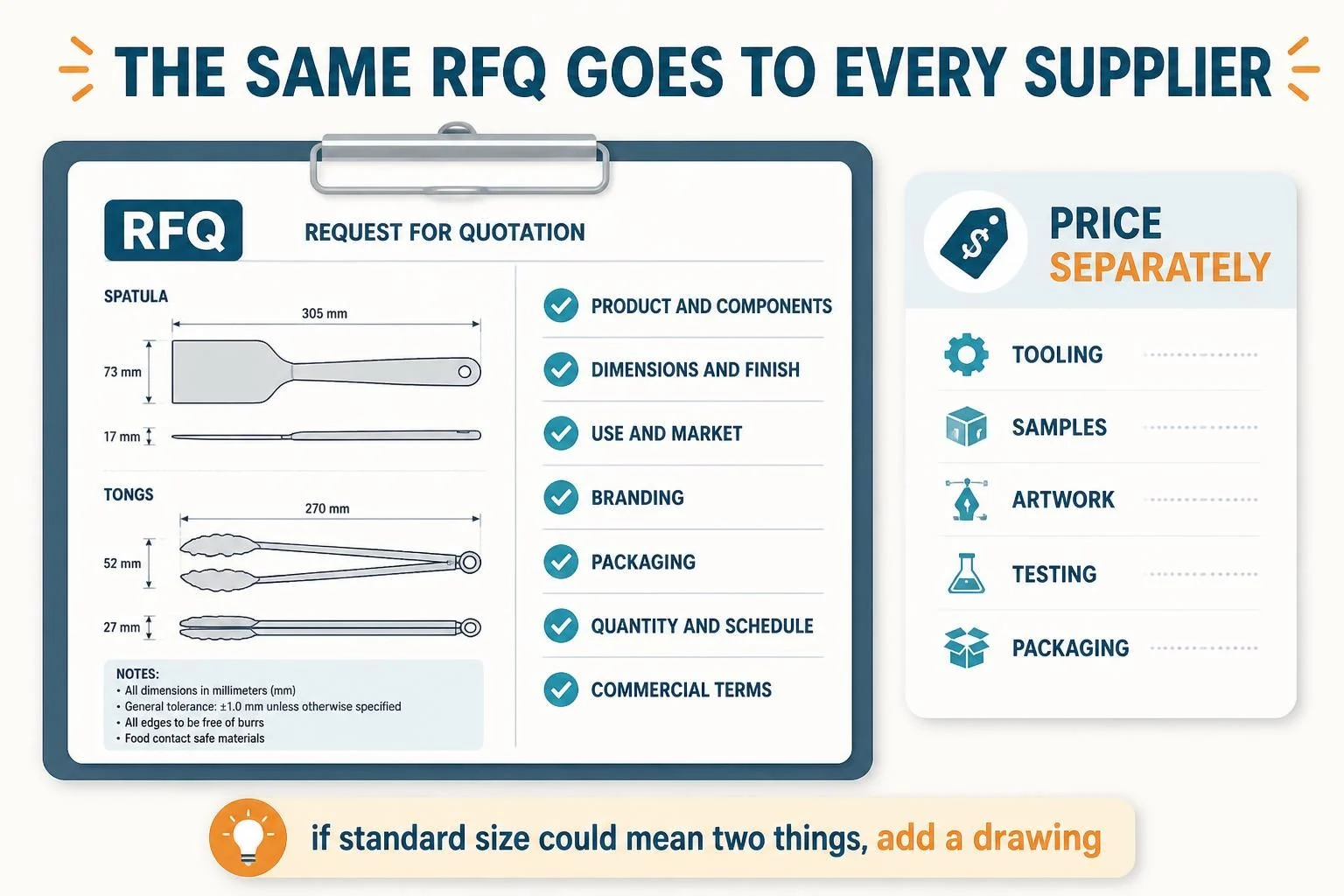
Give every supplier the same product, quantity, packaging, destination, and delivery assumptions. Attach a drawing or annotated photo, and describe each component rather than relying on a product title or marketplace link. If you are open to alternatives, identify the variable and ask suppliers to price each proposed change separately.
| Champ de demande de devis | Que fournir |
|---|---|
| Product and components | SKU, photo/drawing, component material, construction, and function |
| Dimensions et finition | Size, weight if needed, tolerances, color reference, texture, edge/finish |
| Use and market | Food-contact use, heat or cleaning claims, target country, required evidence |
| Branding | Logo position, method, artwork, labels, barcode, insert or instructions |
| Emballage | Unit pack, set configuration, retail box, master carton, marks and carton data |
| Quantité et calendrier | Trial quantity, repeat forecast if known, price breaks, target ship window |
| Conditions commerciales | Sample/tooling/testing fees, MOQ, payment terms, quote validity, Incoterm and named place |
Request separate prices for tooling, samples, artwork, testing, and packaging. State whether you want a quote for one SKU or a set, and choose quantity breaks that fit your buying plan. Minimum order quantities vary with the product, customization, materials, and factory setup, so confirm them with each supplier.
Review the RFQ from a supplier’s point of view. If “standard size” could mean more than one thing, add a measurement or drawing. For a broader category order, see how to source kitchenware from China.
How should you check food-contact claims and documents?
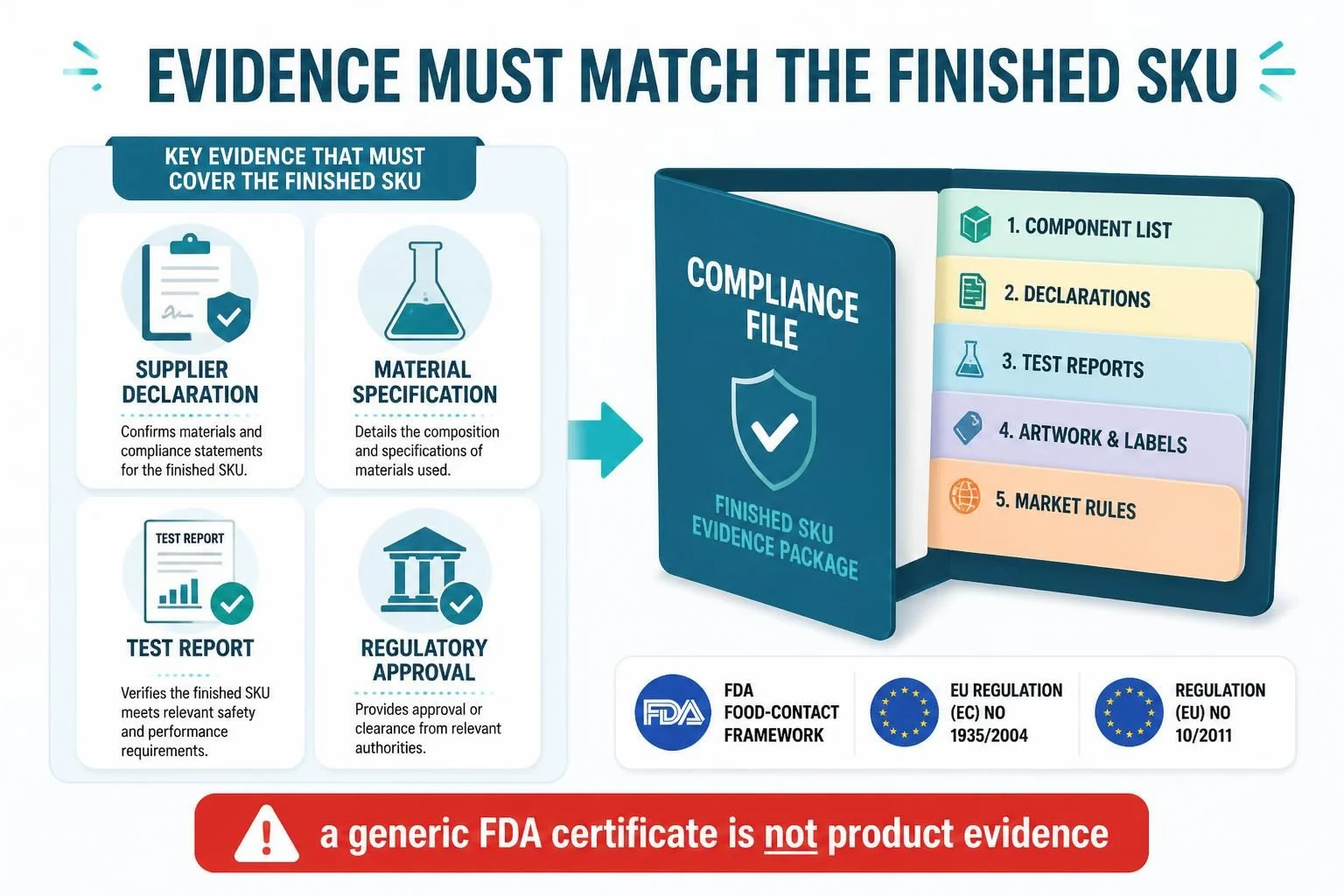
Request evidence for the exact SKU, materials, intended use, and destination market. A supplier declaration, material specification, test report, and regulatory approval serve different purposes. A document for one resin, color, or product version may not cover another finished utensil. Check the document’s scope, date, test method, laboratory, and sample identity before relying on it.
Keep a compliance file for each SKU with its component list, supplier declarations, applicable test reports, approved artwork and labels, and the decision on which market rules apply. For plastic parts used with food in the EU, check the current text and scope of Règlement (UE) n ° 10 / 2011 alongside the framework regulation. Applicability can depend on composition and conditions of use.
Do not ask for a generic “FDA certificate” as a substitute for checking a product. FDA’s food-contact framework concerns substances and their authorized conditions of use; it does not mean every finished utensil receives blanket FDA approval. Apply the same caution to claims such as CE, LFGB, “BPA-free,” heat resistance, or dishwasher safety. Ask for the evidence behind each claim and have a qualified adviser confirm whether it applies to your product and market.
Before production, check that the documents cover the finished SKU and its components, intended food contact, use conditions, target market, test method, laboratory, sample identity, and report date. Ask the supplier or laboratory to explain any mismatch.
How do you inspect kitchen tools and utensils before shipment?
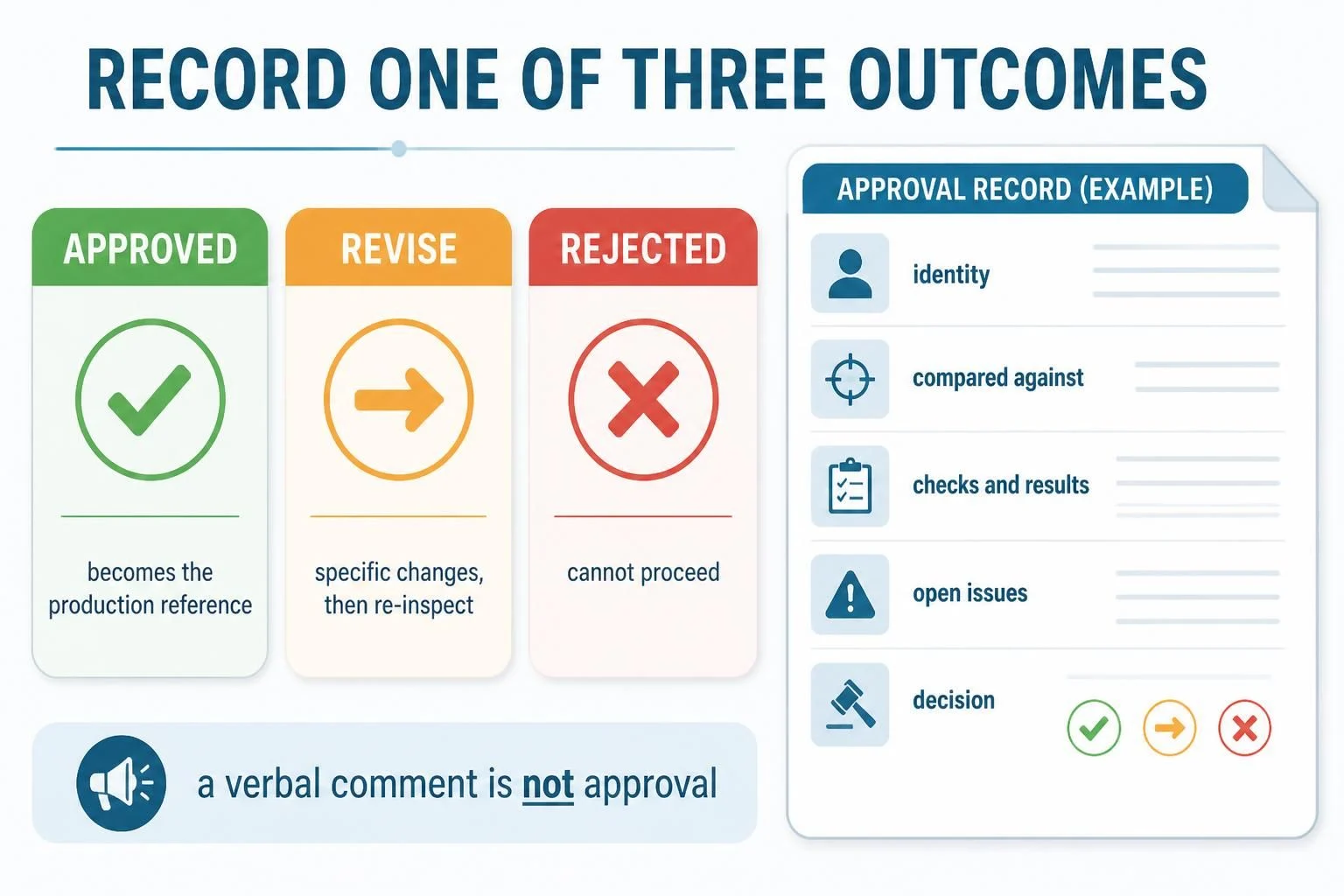
Approve a sample against a written specification, then keep the approved sample or a signed photo record as the production reference. Record the version, material, color, dimensions, logo, packaging, and any agreed tolerances. If the supplier changes a component or production site, review the effect and approve the change in writing before it enters the order.
Record one of three outcomes for every sample. Approve it only when it meets the agreed criteria and can serve as the production reference. Mark it for revision when specific changes are needed, then inspect the new sample. Reject it if it cannot proceed. A verbal comment or an unmarked sample is not approval; record the decision, date, SKU, and revision.
| Exemple de dossier d'approbation | Que faut-il enregistrer ? |
|---|---|
| Identite | SKU, specification revision, supplier, sample date, and sample stage |
| Comparé à | Drawing/specification revision, agreed tolerances, artwork, and packaging brief |
| Contrôles et résultats | Dimensions, material/construction evidence, finish, function, labels, and packaging; note pass, fail, or not checked for each |
| Questions ouvertes | Specific defect or mismatch, required correction, owner, and resubmission date |
| Décision | Approved, revise, or rejected; approver name, date, and retained sample/photo reference |
Describe each revision in measurable terms: identify the dimension to change, component to replace, or artwork position to move. Recheck the affected requirements on the next sample. Once approved, mark the retained sample and specification with the same revision identifier. Require written approval before production deviates from that reference.
Check product function as well as appearance. For tongs, test movement and locking. For whisks, check wire attachment and handle security. For peelers and graters, verify blade security and safe packaging. For silicone or plastic tools, assess odor, surface, color consistency, and the claims you intend to make. Agree test conditions and pass criteria for the actual product; do not copy universal thresholds from an unrelated item.
| Poste de contrôle | Exemple de vérification |
|---|---|
| Identité et quantité | SKU, color, set contents, labels, and order quantity match the approved record |
| Dimensions et finition | Measure agreed points; check surface, edges, flash, burrs, cracks, or chips |
| Construction | Check handle, joints, welds, core, moving parts, and attachment security |
| Fonction | Operate the tool under an agreed method and compare with approved sample |
| Emballage | Check unit pack, protective parts, barcode, carton marks, and carton condition |
| Claims and documents | Match labels and reports to the final product version and target market |
Set inspection timing, sampling, and acceptance criteria in the purchase agreement. Depending on the product and order, you may need checks at production start, during production, or before shipment. Give the inspector the approved sample and specification as references. See the Guide d'inspection de la qualité en Chine for more on planning an inspection.
For a product-specific inspection plan, use the approved sample, written acceptance criteria, and packaging requirements as the reference for every check.
How do you compare quotes and plan the first order?
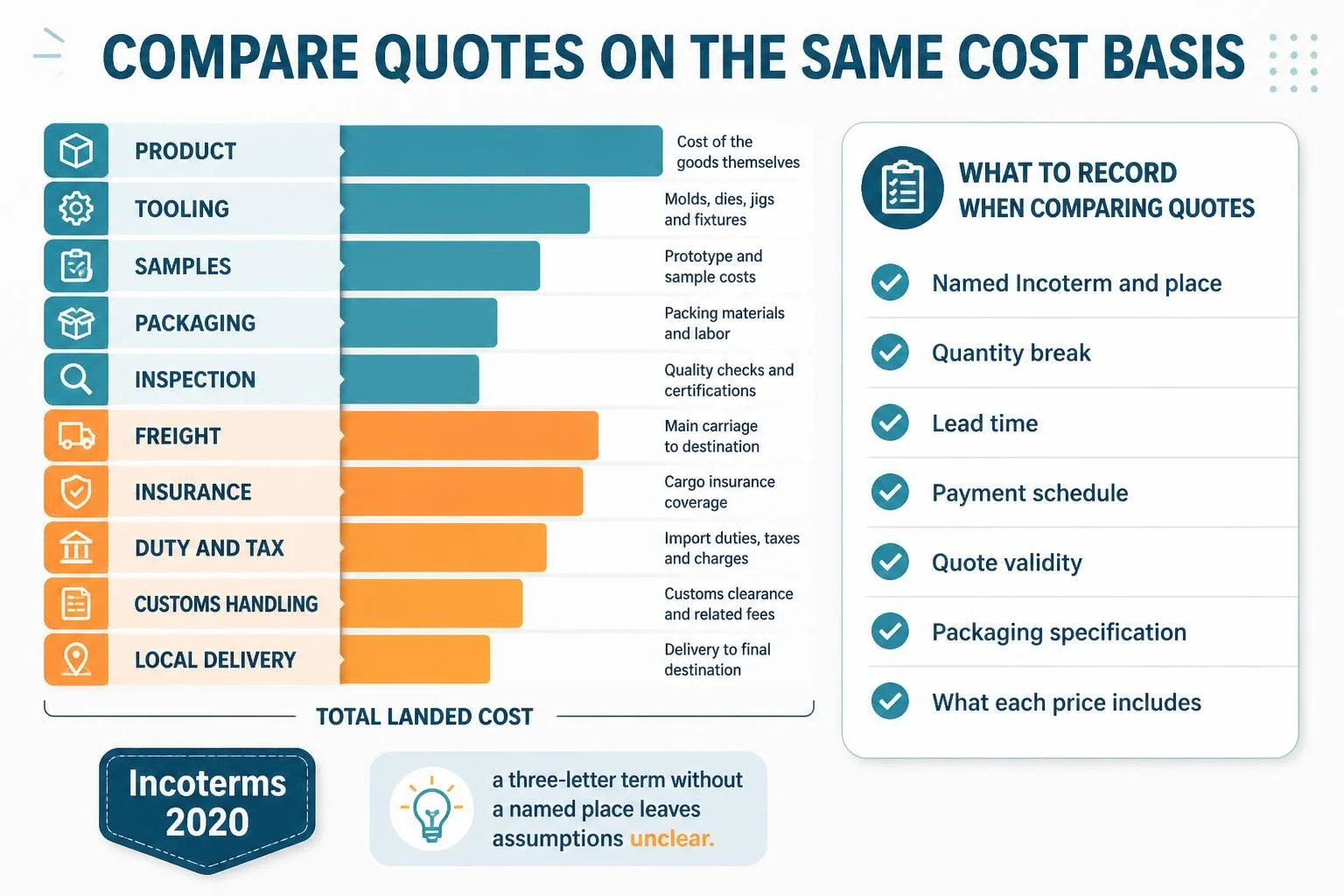
Compare quotes on the same cost basis. Include product price, tooling, samples, packaging, inspection, freight, insurance where applicable, duties and taxes, customs handling, and local delivery. If packaging or expected damage affects the number of sellable units, account for that in your per-unit comparison. Ask your freight provider or customs professional to confirm destination charges and duty assumptions.
Record the named Incoterm and place, quantity break, lead time, payment schedule, quote validity, packaging specification, and what each price includes. The Règles Incoterms de la CCI allocate specific responsibilities between buyer and seller; a three-letter term without a named place can leave assumptions unclear. Ask your freight provider to confirm the routing, destination charges, and service available for your shipment.
If demand is uncertain, consider starting with fewer SKUs or simpler customization. Ask suppliers to quote those options so you can see how they affect MOQ and unit price. Before paying the balance, confirm that the approved sample, production record, inspection result, labels, and shipping documents all refer to the same product version.
Questions fréquemment posées
How do I find a reliable kitchen utensil supplier in China?
Build a shortlist from marketplaces, fairs, referrals, or a sourcing service. Verify the legal entity and payee, ask who performs each production step, request relevant material and quality records, and compare a production-representative sample with your written specification. No single badge or document replaces these checks.
Which material is best for kitchen utensils?
There is no best material for every utensil. Choose based on function, heat exposure, cleaning, expected life, construction, target price, and market requirements. Specify each component, then check the supplier’s evidence and test conditions against the finished product you plan to sell.
What documents should I request for food-contact utensils?
Start with a material/component list, relevant supplier declarations, and applicable test reports. Confirm that each record identifies or clearly covers the material, product version, intended use, test method, laboratory, and target market. FDA and EU rules differ; ask a qualified adviser to confirm which requirements apply to your product.
How do I compare quotes from different utensil suppliers?
Send the same specification, packaging, quantity breaks, target market, and Incoterm to each supplier. Compare tooling, samples, testing, freight assumptions, payment terms, lead time, and quote validity alongside unit price. Ask suppliers to list any proposed material or construction substitutions separately.
What should I check before kitchen utensils ship?
Check product identity, dimensions, finish, edges, joints, function, set contents, labels, and packaging against the approved record. Use the inspection method and acceptance criteria agreed before production. Confirm that any required report or declaration matches the final SKU and that cartons and shipping marks meet the order instructions.
Put the details in writing before you order
Keep the product specification, supplier records, compliance evidence, approved sample, inspection criteria, and delivery terms tied to the same SKU revision. Define the product and intended use first. Then compare suppliers against the same brief and confirm the final sample and order terms in writing.
Besoin d'aide pour trouver des produits de cette catégorie ? Parlez à notre équipe about your kitchen tools and utensils brief and request a quote.

Gong Zheng est rédacteur de blog pour GreentimeSpécialisé dans l'approvisionnement mondial, les tendances du marché de gros et les conseils pratiques aux acheteurs internationaux, cet ouvrage s'appuie sur une vaste expérience en marketing digital et en commerce transfrontalier. Il partage son expertise pour aider les PME à s'approvisionner plus efficacement et à éviter les pièges courants. Passionné par la mise en relation des acheteurs avec des fournisseurs fiables, il écrit dans un style clair et accessible qui simplifie les sujets complexes.