China has become the top sourcing destination for Amazon FBA sellers worldwide. With competitive pricing, flexible private label options, and a massive manufacturing network, it offers huge opportunities for both new and experienced sellers.
However, sourcing products from China also comes with challenges — from unreliable suppliers and quality issues to shipping delays and hidden costs.
In this guide, you’ll learn how to source products from China for Amazon FBA step-by-step, avoid common mistakes, and build a more reliable supply chain for your business.
1.Why Amazon Sellers Source Products from China
For most Amazon sellers, sourcing from China is the fastest way to build a profitable product line. The main driver is simple: you get lower unit costs while keeping enough margin to compete on Amazon.
Cost advantage is the first reason. Chinese factories operate at scale, with lower labor and production costs. This allows wholesale buyers and Amazon FBA sellers to secure factory pricing that’s hard to match in local markets.
Another key factor is MOQ flexibility. Many suppliers in China support low minimum order quantities, especially for new sellers testing products. This makes it easier to start small, reduce risk, and scale step by step.
China is also the global hub for private label manufacturing. You can customize packaging, branding, and even product features without building your own factory. This is a major advantage for e-commerce sellers who want to create differentiated listings on Amazon.
Behind all of this is a strong manufacturing ecosystem. From raw materials to assembly lines and packaging suppliers, everything is concentrated in one supply chain network. For Amazon sellers, this means faster sampling, shorter lead times, and easier product iteration.
Put together, this ecosystem gives wholesale buyers and e-commerce operators direct access to a complete supply chain — from prototype to mass production — all in one place.
2.How to Find Winning Products for Amazon FBA
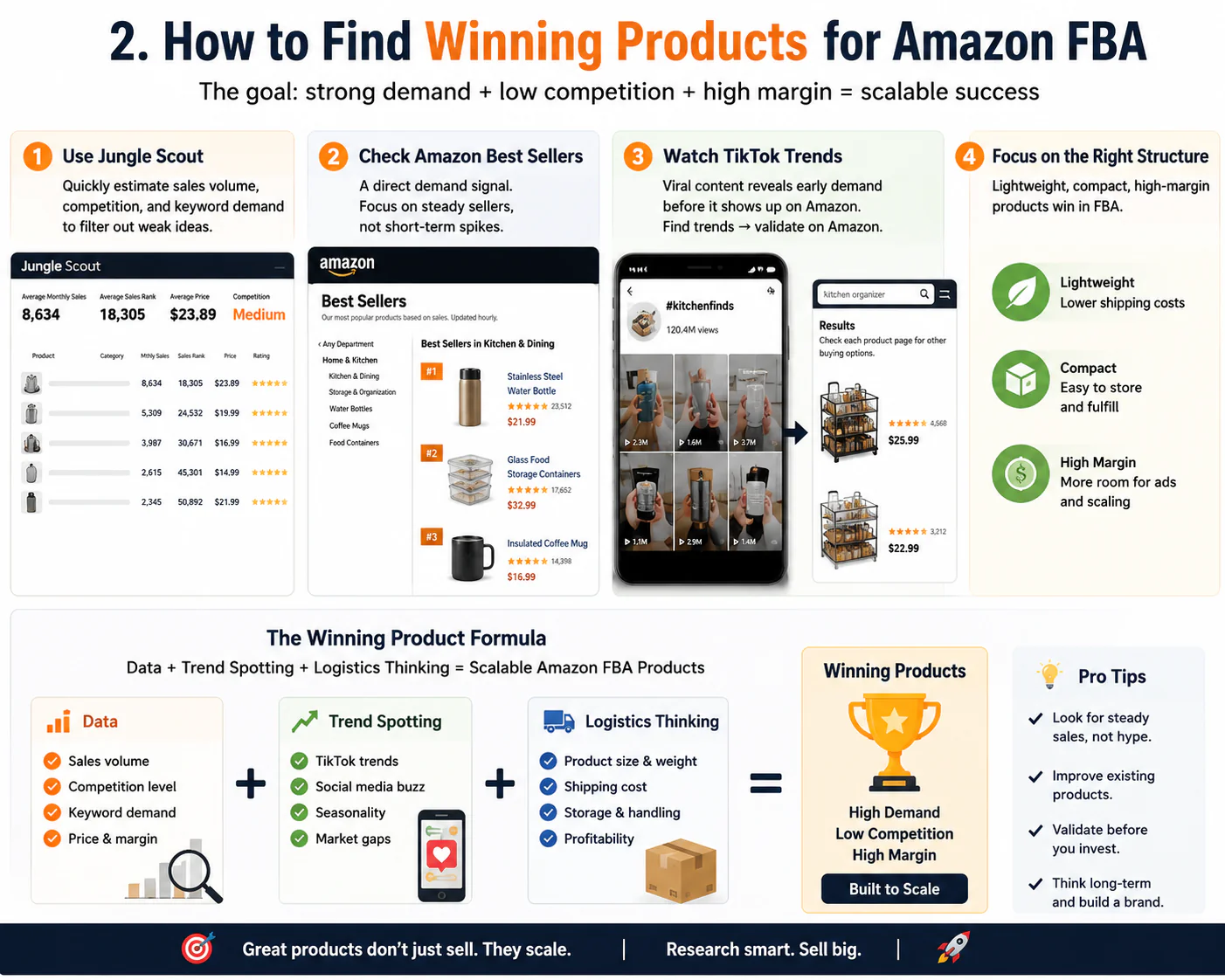
Finding winning products is where most Amazon sellers make or break their business. The goal is simple: pick products with strong demand, low competition, and enough margin to scale.
One of the most common starting points is Jungle Scout. It helps you estimate sales volume, competition level, and keyword demand on Amazon. For many wholesale buyers and FBA sellers, it’s a quick way to filter out weak ideas before investing in samples.
You can also use Amazon Best Sellers as a direct demand signal. These rankings show what’s already moving fast in real time. Look for products with steady sales patterns, not just short-term spikes. This helps you understand what the market is already validating.
Outside Amazon, TikTok trends are becoming a strong product discovery channel. Viral videos often reveal early-stage demand before it shows up in Amazon search volume. Smart sellers track trending hashtags, then check if similar products already exist on Amazon with room for improvement.
Product selection also comes down to structure. The best-performing items are often lightweight, compact, and high-margin. These products are cheaper to ship, easier to store, and leave more room for advertising costs — a key advantage in a competitive supply chain.
Put all of this together, and winning product research becomes a mix of data + trend spotting + logistics thinking. That combination is what separates average listings from scalable Amazon FBA products.
3.Alibaba vs Yiwu Market vs China Sourcing Agents
When you source for Amazon FBA, your sourcing channel directly affects your price, risk, and speed. Most Amazon sellers compare three main options: Alibaba, Yiwu Market, and China sourcing agents. Each works differently in the supply chain, and the right choice depends on your stage and product strategy.
Here’s a clear breakdown:
| Option | Best For | Advantages | Limitations |
| Alibaba | New sellers, online sourcing | Huge supplier database, easy to search, direct factory contact | Hard to verify real factories, higher communication risk, inconsistent quality |
| Yiwu Market | Small orders, fast sampling | Extremely low MOQ, fast sourcing, wide product variety in one place | Requires on-ground sourcing, harder for overseas buyers to navigate alone |
| China Sourcing Agents | Scaling sellers, long-term sourcing | Factory verification, negotiation support, QC control, logistics handling | Service fee involved, depends on agent quality |
Alibaba works well when you want quick product ideas and direct contact with suppliers. But for many wholesale buyers, it can be difficult to confirm if a supplier is a real manufacturer or just a trading company.
Yiwu Market is more practical when you need low MOQ and fast product testing. It’s especially useful for Amazon sellers who want to validate products before committing to large production runs.
China sourcing agents sit in the middle — and often at the most efficient point in the supply chain. They help you move from product idea to factory production, while handling negotiation, sampling, quality inspection, and shipping coordination.
For sellers scaling beyond testing phase, this is where sourcing becomes less about finding products and more about managing risk and consistency.
That’s also where Greentime fits in — helping you move from scattered supplier searches to a stable sourcing system across verified factories, especially when you need better control over MOQ, quality, and delivery timelines.
4.Understanding MOQ, Lead Time, and Sample Orders
Before you place any order in China, three terms shape your entire sourcing strategy: MOQ, lead time, and sample order. For most Amazon sellers and wholesale buyers, these directly decide cash flow, risk level, and how fast you can test a product in the supply chain.
MOQ (Minimum Order Quantity)
MOQ is the smallest quantity a factory will accept per order. It can range from 50 units to 5,000+ depending on the product.
For new Amazon sellers, MOQ is often the first barrier. Too high, and you over-invest in untested products. Too low, and unit cost usually increases.
China sourcing agents help you negotiate MOQ with factories, especially when you need to test multiple SKUs or launch a private label product with limited risk.
Lead Time
Lead time is the total time from order confirmation to finished production and shipment readiness.
Typical lead times in China:
- Simple products: 7–15 days
- Custom/private label products: 20–45 days
- Peak season orders: longer due to factory load
For wholesale buyers, lead time impacts inventory planning and Amazon stock levels. A delay in production often means missed sales windows, especially for seasonal products.
Sample Order
A sample order is your first physical check before mass production. It lets you test quality, packaging, size, and branding.
Most factories charge a small fee for samples, but this step reduces costly mistakes later in the supply chain.
For Amazon FBA sellers, sample orders are where product decisions become real. You can compare multiple factories, test durability, and confirm whether the product matches your listing strategy.
Together, MOQ, lead time, and sample orders define how flexible your sourcing process is. If you manage them well, you reduce risk while moving faster from idea to market-ready product.
5.How to Avoid Quality Problems When Sourcing from China
Quality issues usually don’t happen by accident. They happen when there’s no clear control at each stage of production. If you want consistent results, you need a simple system that checks the factory, the process, and the final shipment.
Here’s how you stay in control.
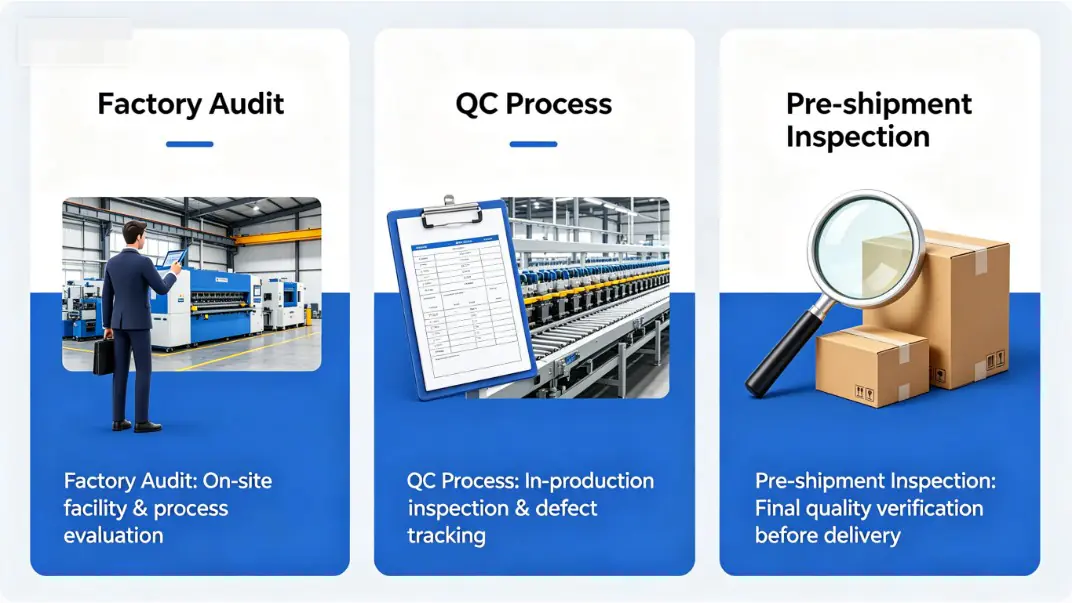
5.1 Factory audit — start by checking the factory, not just the price
A low price means nothing if the factory can’t deliver stable quality. A factory audit helps you confirm who you are really working with before you place an order.
You should look at:
- Production capacity and real output (not just what they claim)
- Supplier stability and business license
- Equipment condition and production lines
- Past export experience and client types
A proper factory audit reduces the risk of working with trading companies disguised as manufacturers. It also tells you if the factory can actually handle your order volume and quality standards.
5.2 QC process — control quality during production, not after shipment
If you only check goods at the end, you’ve already lost most of your control. A structured QC process keeps quality stable throughout production.
A basic QC flow includes:
- Raw material inspection before production starts
- In-line inspection during mass production
- Random checks on finished goods
This helps you catch issues early, when fixes are still cheap and fast. It also keeps the factory accountable instead of relying on final inspection alone.
5.3 Pre-shipment inspection — your final checkpoint before payment
Pre-shipment inspection is your last chance to stop defective goods from leaving the factory. It happens when production is finished but before goods are shipped.
At this stage, you should check:
- Product appearance and function
- Packaging quality and labeling
- Quantity accuracy vs. PO
- Consistency across random samples
Many buyers skip this step and only trust the factory’s internal QC. That’s where problems usually slip through. A third-party or agent-led inspection gives you an independent view before you release final payment.
6.FOB vs CIF: Which Shipping Method Is Better for Amazon Sellers?
Your shipping terms decide more than cost. They control risk, delivery speed, and how much visibility you have over your cargo. For Amazon sellers, that difference can directly affect margins and stock availability.
Let’s break down FOB vs CIF in a practical way.
6.1 What is FOB (Free on Board)?
FOB means the supplier delivers your goods to the port in China and handles export clearance. After that, you take full control of shipping.
In simple terms:
- Supplier handles factory → port
- You (or your forwarder) handle international shipping
With FOB, you get:
- Better control over freight cost
- Flexibility to choose your own forwarder
- Clearer shipping breakdown for Amazon FBA planning
This is why most experienced Amazon sellers prefer FOB. You avoid hidden logistics markups and can optimize shipping routes.
6.2 What is CIF (Cost, Insurance, Freight)?
CIF means the supplier handles shipping all the way to your destination port, including freight and insurance.
In simple terms:
- Supplier controls shipping until arrival port
- You pay one bundled cost
With CIF, you get:
- Less coordination work
- Easier process for beginners
- Faster quoting (one price covers everything)
But there’s a trade-off. You lose visibility and control over freight costs. Suppliers often add a margin into shipping fees, which can make CIF more expensive than it looks.
6.3 FOB vs CIF: Quick Comparison
| Factor | FOB | CIF |
| Cost transparency | High | Low |
| Control over shipping | Full control | Limited control |
| Ease for beginners | Medium | Easy |
| Freight pricing | Market rate | Marked-up bundle |
| Best for Amazon FBA | Yes | Sometimes |
6.4 Which is better for Amazon sellers?
If you are scaling an Amazon FBA business, FOB is usually the better choice.
Why:
- You can work with Amazon-ready freight forwarders
- You reduce hidden shipping costs
- You gain flexibility on DDP, air freight, or sea freight options
CIF can work for small test orders or early-stage sourcing, but it becomes limiting once you start optimizing margins and logistics.
6.5 FAQ
Q1. Is FOB cheaper than CIF?
In most cases, yes. FOB lets you negotiate freight directly with forwarders, often at lower market rates.
Q2. Does Amazon FBA require FOB or CIF?
Amazon doesn’t require either. But FOB is more commonly used because it works better with FBA logistics workflows.
Q3. Is CIF safer for beginners?
It feels safer because it’s simpler, but it can hide extra shipping costs and reduce your control.
Q4. Can I switch from CIF to FOB later?
Yes. Many buyers start with CIF for small orders and move to FOB once they scale.
7.How Much Does Amazon FBA Sourcing Cost?
Amazon FBA sourcing costs are more than just the product price. If you only compare supplier quotes, you can easily underestimate your real landed cost.
Most Amazon sellers need to budget for:
- Product sourcing fee
- Inspection fee
- Shipping costs
- Import tariffs and duties
- Packaging and labeling
Here’s what each cost usually looks like.
7.1 Sourcing fee
If you use a sourcing agent in China, you’ll usually pay a sourcing fee based on your order value.
Common pricing models:
- 3%–10% of order value
- Flat fee for small orders
- Included in supplier pricing for large-volume buyers
A sourcing fee normally covers:
- Supplier search and negotiation
- Sample coordination
- Order follow-up
- Factory communication
- Production tracking
For Amazon sellers, this can save time and reduce expensive sourcing mistakes — especially if you are managing multiple SKUs.
7.2 Shipping costs
Shipping is often the largest variable cost in Amazon FBA sourcing.
Your total depends on:
- Air freight vs sea freight
- Product size and weight
- Shipping season
- Destination country
- DDP, FOB, or CIF terms
Typical ranges:
- Air freight: fast but expensive
- Sea freight: slower but much cheaper for larger orders
Many Amazon sellers use sea freight once they scale because shipping cost per unit becomes lower.
7.3 Tariffs and import duties
Tariffs can significantly affect your profit margin.
Your duty rate depends on:
- Product category
- HS code
- Country of import
- Current trade policies
For U.S. imports from China, some products may also face additional Section 301 tariffs.
Before placing an order, you should calculate:
- Import duty
- Customs clearance fees
- VAT or GST (if applicable)
Ignoring tariffs is one of the most common mistakes new Amazon sellers make.
7.4 Packaging and Amazon FBA prep
Amazon has strict packaging and labeling requirements. If your products are not prepared correctly, Amazon may reject inventory or charge extra fees.
Common FBA prep costs include:
- Poly bags
- Barcode labels
- Carton labeling
- Insert cards
- Custom packaging
- Bundling and kitting
Simple packaging may only add a few cents per unit. Custom retail packaging can add much more depending on materials and print quality.
7.5 Example: Estimated Amazon FBA Sourcing Cost Breakdown
| Cost Item | Typical Range |
| Product cost | Depends on SKU |
| Sourcing fee | 3%–10% |
| Inspection fee | $150–$400 |
| Shipping | Varies by method |
| Tariffs & duties | Depends on HS code |
| FBA packaging & prep | Per-unit cost |
8.Common Mistakes New Amazon Sellers Make
Many Amazon sellers focus on finding a product fast. The problem is that small sourcing mistakes early on can turn into expensive problems later.
After years of working with Amazon buyers, these are the issues we see most often.
8.1 Choosing the lowest price instead of the best supplier
The cheapest quote is rarely the cheapest outcome.
Low-price suppliers often cut corners on:
- Materials
- Packaging
- Production consistency
- Quality control
Some factories also lower prices at the sample stage, then reduce quality during mass production.
A slightly higher factory price from a stable supplier usually saves you more money over time. Fewer defects, fewer returns, and fewer shipment delays matter far more than saving a few cents per unit.
8.2 Skipping sample orders
Many new sellers rush straight into bulk production to save time.
That’s risky.
Samples help you verify:
- Product quality
- Material consistency
- Packaging standards
- Product dimensions
- Real-life usability
A product can look perfect in photos and still fail once you hold it in your hand. Sample testing also helps you catch problems before you commit to a large MOQ.
Experienced Amazon sellers almost never skip this step.
8.3 Ignoring IP risks
Intellectual property problems can shut down a listing very quickly.
Common mistakes include:
- Copying patented products
- Using protected logos or designs
- Selling branded-style products without permission
- Trusting suppliers who claim “everyone sells this”
Many factories do not check overseas IP compliance. That responsibility usually falls on the seller.
Before launching a product, it’s smart to check:
- Trademarks
- Design patents
- Utility patents
- Amazon restricted product policies
This becomes even more important in competitive categories.
8.4 Using bad packaging
Packaging affects more than appearance.
Weak or poorly designed packaging can cause:
- Product damage during shipping
- Higher return rates
- Negative reviews
- Extra Amazon prep fees
For Amazon FBA, packaging also needs to meet strict warehouse and barcode requirements.
Good packaging should protect the product, reduce shipping waste, and arrive in sellable condition after long-distance transport.
8.5 Expecting unrealistic margins
Many beginners calculate profit using only:
- Product cost
- Amazon referral fee
But real margins also include:
- Shipping
- Tariffs
- PPC advertising
- Returns
- Storage fees
- Inspection costs
- Packaging and prep
A product that looks profitable on paper can quickly become unprofitable after all costs are added.
Strong Amazon sellers calculate full landed cost before placing inventory orders.
9.Should You Use a China Sourcing Agent?
If you’re sourcing from China, the real question is how much risk and time you want to handle yourself. A sourcing agent helps you bridge language gaps, supplier checks, and order coordination so you don’t have to manage everything alone.
You don’t always need one. But in certain situations, working with an agent can reduce costly mistakes and speed up your sourcing process.
9.1 When a sourcing agent actually makes sense
You’ll get the most value from a sourcing agent if you fall into one of these situations:
- First-time importers
You’re still learning how MOQ, sampling, and shipping work. A small mistake here can turn into expensive delays.
- Working with multiple suppliers
Managing different factories means more follow-ups, more coordination, and higher risk of inconsistency. An agent helps consolidate everything.
- Custom packaging or private label products
When you need branding, packaging changes, or OEM/ODM work, communication errors with factories are common without local support.
- Negotiating low MOQ orders
Some factories won’t move on MOQ or pricing unless the order is structured properly. Local negotiation often helps unlock better terms.
- Quality concerns or stricter QC needs
If product consistency matters, inspections before shipment can prevent defects from reaching your customers.
9.2 When you may not need one
If you’re placing simple repeat orders with a single trusted supplier, or you already have a strong factory relationship in China, you might not need an intermediary. In those cases, direct communication can be faster.
9.3 A simple way to decide
If your sourcing involves risk, complexity, or multiple moving parts, an agent usually pays for itself in reduced mistakes and saved time. If it’s a straightforward reorder, you can often manage it directly.
For many buyers, it starts with one or two complex orders — then expands once they see where the bottlenecks are.
If you want to test it without fully committing, you can start with a single product or supplier and scale support as your sourcing needs grow.
Conclusion
Sourcing products from China for Amazon FBA can be one of the most effective ways to grow a profitable e-commerce business — but success depends on more than simply finding the cheapest supplier.
The best Amazon sellers focus on building reliable supply chains, testing product quality carefully, understanding shipping costs, and creating long-term relationships with trusted manufacturers.
Whether you choose to source through Alibaba, Yiwu Market, or a professional sourcing agent, the key is to reduce risk while maintaining consistent product quality and healthy profit margins.
For new Amazon sellers, the sourcing process can feel overwhelming at first. But with the right strategy, proper supplier verification, and a strong quality control process, importing from China becomes far more manageable and scalable.
If you plan to grow your Amazon FBA business long-term, investing time in finding the right sourcing partners will give you a major competitive advantage.
Need help sourcing products from China for Amazon FBA?
Greentime helps Amazon sellers:
- Find verified suppliers
- Negotiate better MOQ and pricing
- Conduct factory audits and quality inspections
- Manage packaging and private label production
- Coordinate shipping directly to Amazon warehouses
Contact our sourcing team to discuss your next Amazon FBA product launch.

Tennie Chen is responsible for sourcing and supplier evaluation, with a focus on balancing product quality, cost efficiency, and supply chain reliability. My role involves identifying trustworthy manufacturers, comparing quotations, analyzing total landed costs, and ensuring compliance with international standards. I always prioritize long-term partnerships over one-time deals, aiming to work with suppliers who can provide consistent quality, competitive pricing, and flexible solutions. When making purchasing decisions, I evaluate not only the product itself but also the supplier’s production capacity, lead time, and after-sales support, ensuring that every cooperation contributes to sustainable business growth.