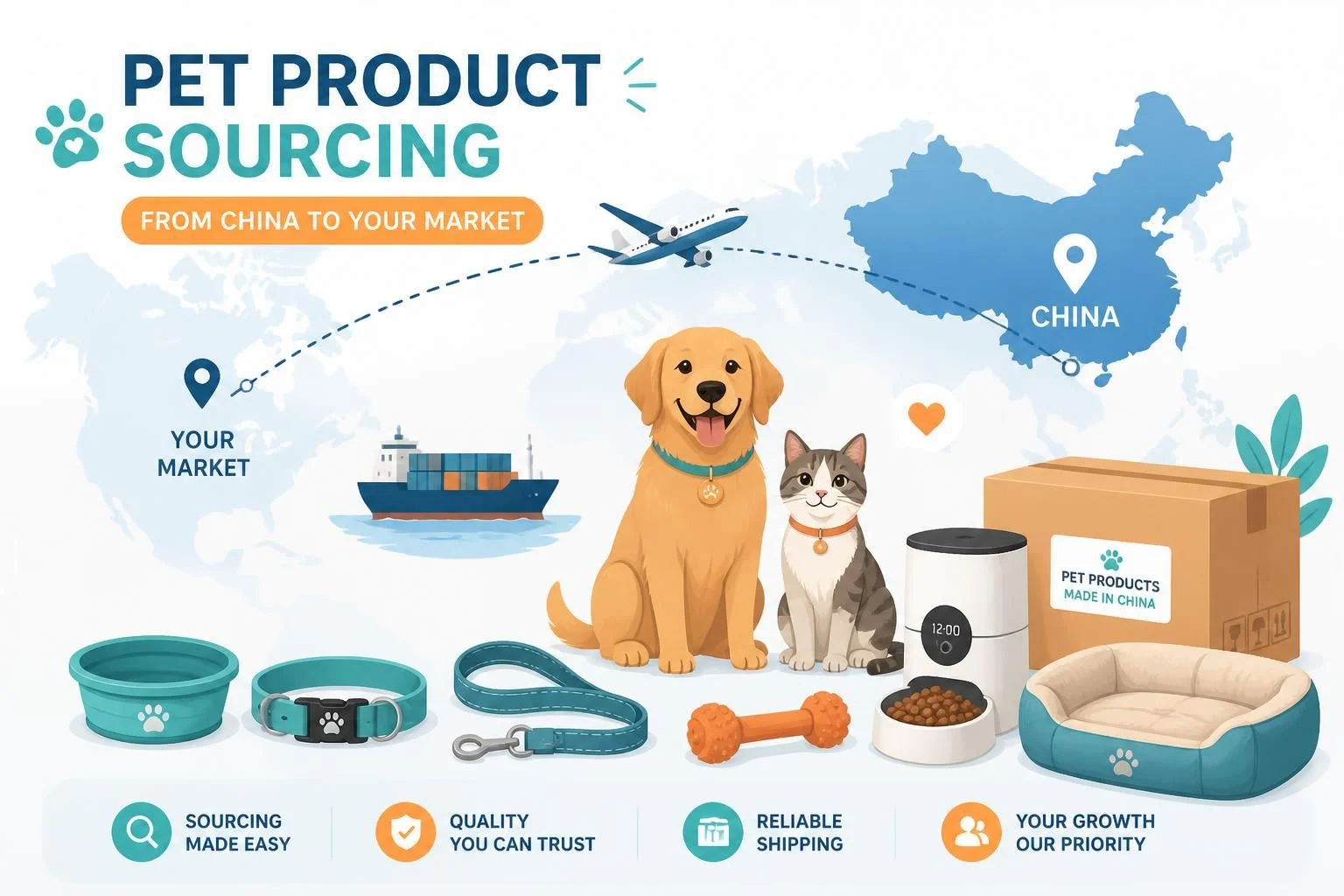
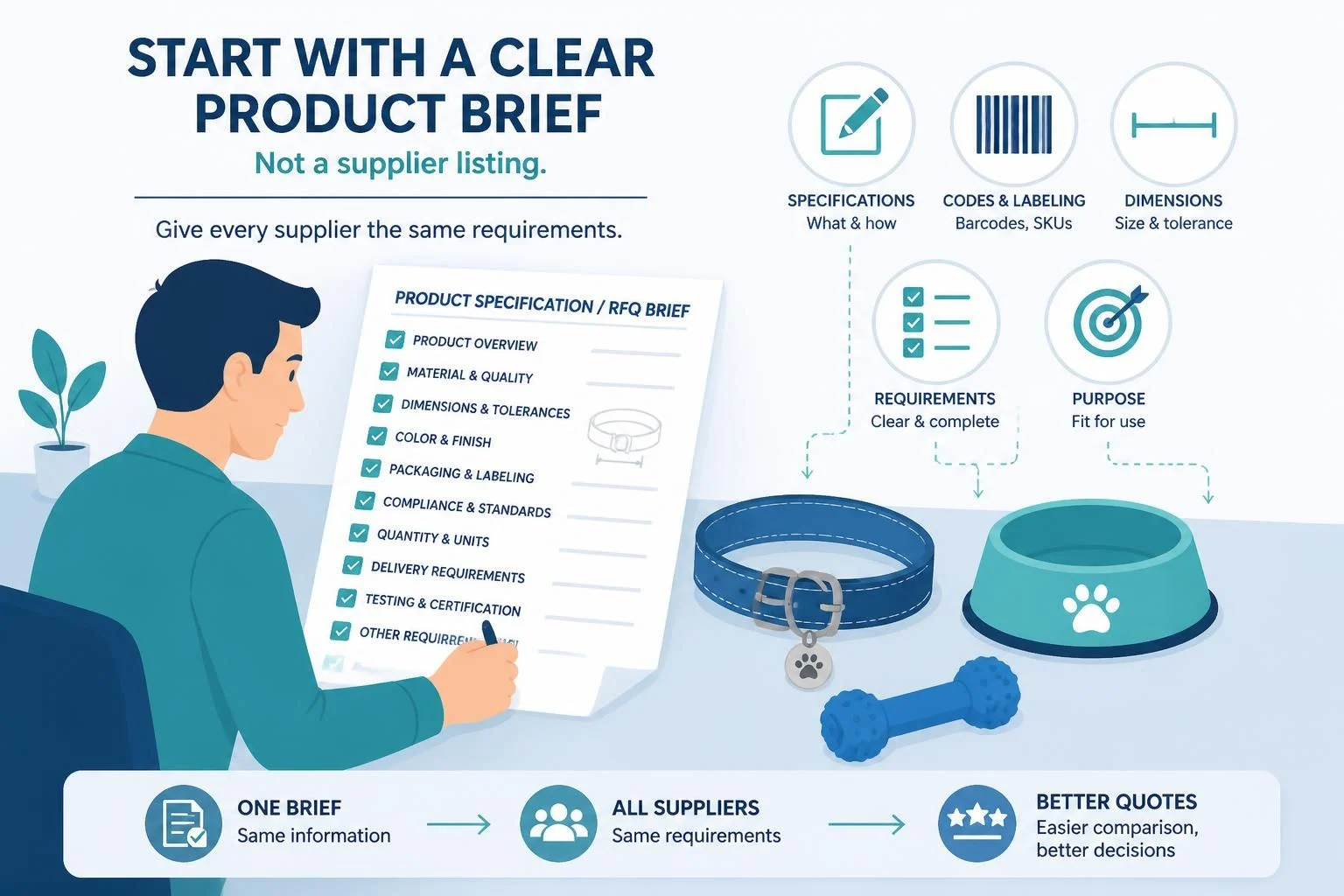
Start with a product brief, not a supplier listing. Write down the item, material, intended pet use, destination market, packaging, quantity, and quality requirements. Then give every supplier the same file, approve a sample, and inspect bulk goods before shipment. This guide is for importers, retailers, and ecommerce sellers buying pet accessories from China.
Pet products cover very different products. A silicone bowl, leash, chew toy, and electronic feeder each raise their own questions about material, use, packaging, testing, and shipping. Your job is to turn the product idea into an order file the supplier, inspector, and freight partner can follow.
Key Takeaways
- Use a written specification so every pet-product supplier quotes the same SKU.
- Verify the supplier, approve a sample, and set measurable QC rules before production.
- Compliance is product- and market-specific; a test report must match the final SKU, materials, and destination.
- Compare landed cost, not only the unit price.
What should a pet product sourcing brief include?
Choose a product you can describe clearly: intended use, material, dimensions, target animal, selling market, and target price. A large pet market does not tell you which SKU will work for your business. A clear brief does. It gives each supplier the same requirements to quote, sample, and produce, so you can compare their answers properly.
For a first order, choose a product with a clear use and few variables. Feeding accessories, grooming tools, beds, apparel, collars, harnesses, leashes, toys, and travel accessories all need different checks. Avoid treating food, supplements, medicines, flea treatments, or products making health claims as ordinary accessories. Those products can involve separate regulatory and import requirements.
| Product group | Questions to define | Common risk to control |
|---|---|---|
| Bowls and feeders | Material, food-contact use, capacity, finish | Wrong material or an unverified food-contact claim |
| Collars, harnesses, and leashes | Pet size, webbing, hardware, stitching, load expectation | Weak assembly or mismatched hardware |
| Toys and chew items | Intended animal, materials, parts, seams, intended use | Loose parts, material substitution, unsupported claims |
| Electronic accessories | Power, battery, plug, wireless function, labels | Electrical, battery, or radio requirements |
Browse pet accessories wholesale to narrow the category, then create a separate brief for each SKU. One “pet range” quotation often hides important differences in materials, sizes, packaging, and MOQ.
If pet toys are part of your range, review our top pet toy manufacturers in China for wholesale before you request quotes. Use it to build a shortlist, then apply the same material, sample, and QC questions to every supplier.
Agree the delivery term, product requirements, and commercial scope in writing before you compare prices. In the same way that a shipping term needs a clear allocation of responsibilities, a product order needs a clear allocation of materials, packaging, testing, and quality requirements. Send every candidate supplier the same RFQ.
- Product name, reference image or drawing, and intended pet or size range
- Exact material, colour, dimensions, weight, and permitted tolerances
- Logo method, artwork version, barcode, labels, and retail packaging
- Required function, accessories, and product-specific test or document questions
- First-order quantity, expected reorder volume, target market, and delivery date
- Requested quote basis, including sample cost, MOQ, lead time, cartons, and Incoterm
Ask suppliers to point out any part of the brief they cannot meet. That is more useful than a quick “yes” followed by changes after you pay a deposit. A reference image starts the conversation. It does not confirm material grade, stitching, finish, function, packaging protection, or a destination-market requirement.
Use this RFQ rule: if a requirement matters to your customer, put it in the supplier file. Product photos are useful references, but written fields are what make samples, purchase orders, and inspections comparable.
Where can you find pet product suppliers in China?
Use marketplaces, trade fairs, referrals, and local sourcing contacts to build a shortlist, then judge suppliers on evidence. A platform profile can help you discover products, MOQs, and potential suppliers. It does not prove that the business can make your exact version, receive payment under the quoted entity, or deliver consistent bulk production.
Build a shortlist of five to ten candidates. Ask each supplier for the same RFQ response, company name, product catalogue, sample path, MOQ, lead time, carton data, and export experience. Keep the answers in one comparison sheet. You will spot missing information much faster than when details are scattered across chat messages.
Where you look depends on the product. Compare Yiwu and Guangzhou pet product wholesale markets if you are deciding where to research suppliers or visit in person. For buyers focused on market-based discovery, our guide to the pet accessories wholesale market explains what to prepare before you start collecting quotes.
Do you need a factory rather than a trading company? Not always. A factory can suit repeat production or custom tooling. A capable trading company may be easier when you need several accessory SKUs in one shipment. Ask who controls the product, sample, quality process, packaging, and delivery. Get the answer in writing.
When you plan to work directly with a producer, read our guide to partnering with a pet supplies factory in China. It complements this article: use that guide to assess the working relationship, then use the checks here to document the supplier, sample, quality criteria, and shipment plan.
For a wider supplier-search process, see our guide on how to find suppliers in China. If you need local supplier comparison, sample coordination, and quotation support, a product sourcing service can manage those steps against your brief.
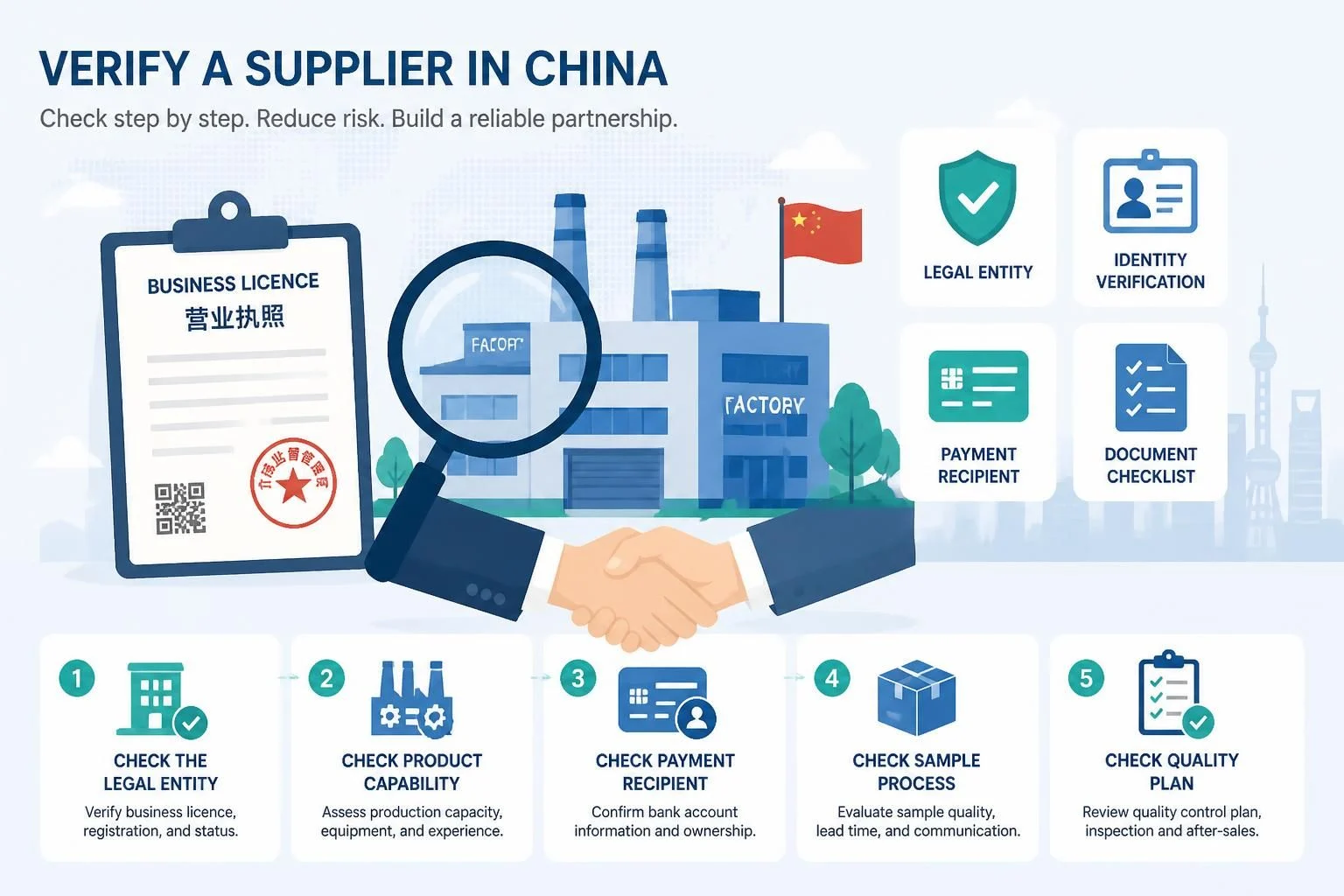
How do you verify a pet product supplier before ordering?
Check the legal entity, product capability, payment recipient, sample process, and quality plan one by one. A business-registration record can confirm that an entity exists and show its registered details. It cannot tell you whether the company owns a factory, can make your final SKU, supports export, or produces consistently.
- Match the entity: compare the company name and address on the business licence, quotation, invoice, contract, and payment account.
- Check product capability: ask about materials, production steps, relevant product records, packaging, and the exact sample route.
- Confirm commercial terms: record MOQ, sample time, production time, payment schedule, tooling, packaging, and domestic delivery.
- Set the QC plan: require measurable acceptance criteria before production starts.
- Check export readiness: request carton dimensions, gross weight, the agreed Incoterm, and the information needed by your forwarder.
Pause and investigate when records conflict, a supplier refuses a sample, the payment beneficiary changes without an explanation, or product requirements are not accepted in writing. A single inconsistency may have a reasonable explanation. Several unresolved inconsistencies are a reason to stop before sending a deposit.
Our guide to verifying a Chinese supplier provides a broader document and payment checklist. For a new supplier or a high-value order, a quality inspection service gives you a local process for checking production against the approved order file.
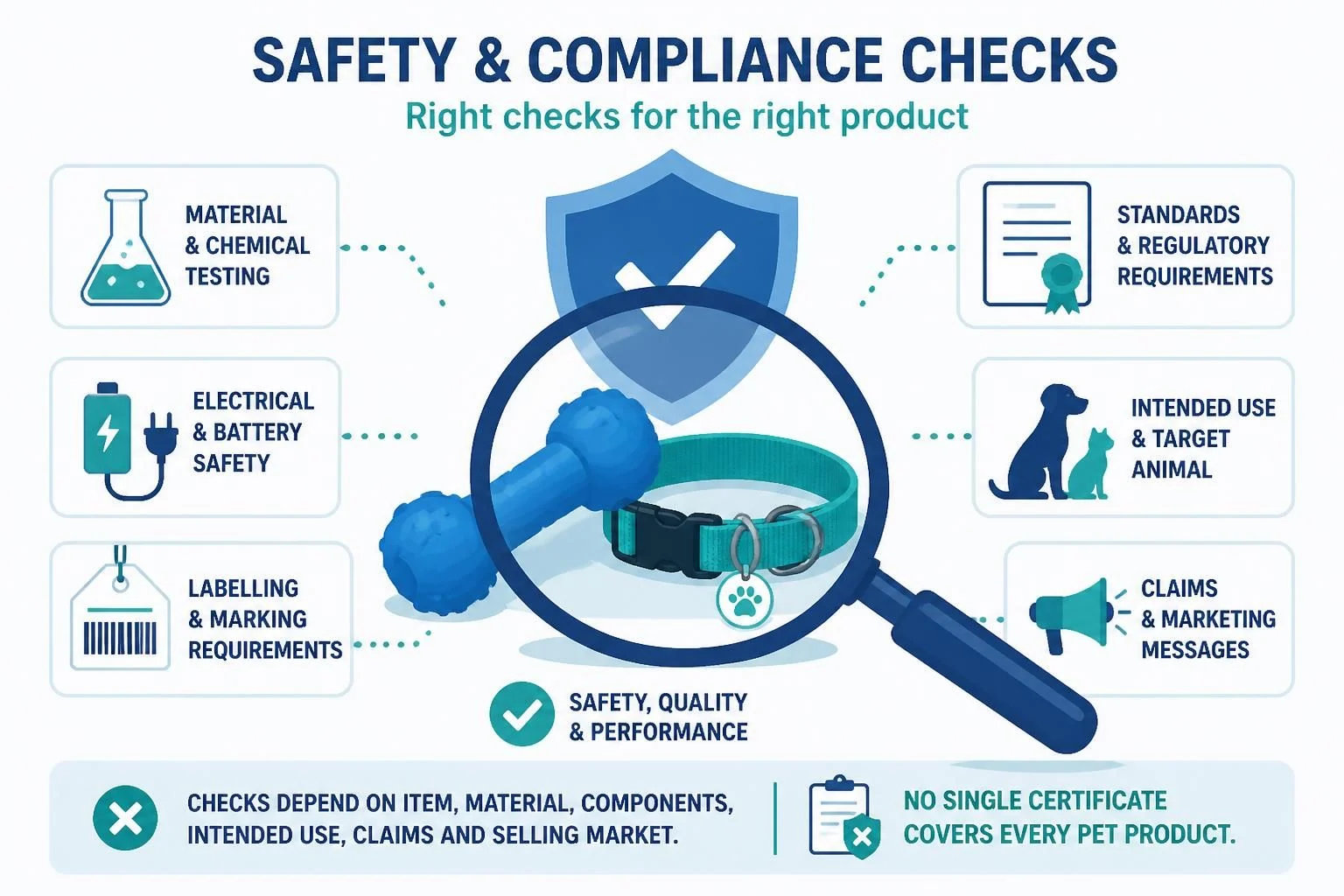
Which safety and compliance checks apply to pet products?
There is no single certificate for every pet product. The checks depend on the item, material, components, intended use, product claims, and selling market. They may involve safety, chemicals, food contact, electrical parts, wireless functions, or labels. Before production starts, confirm what applies with the importer of record, a qualified laboratory, and the relevant regulator.
For chew toys or products likely to be mouthed, ask what materials and parts are used, how seams or components are secured, and which destination-market restrictions may apply. For collars, harnesses, and leashes, agree the material, hardware, assembly, and appropriate performance checks in the specification. Do not publish a universal pull-strength figure unless it is tied to the product, animal size, test method, and intended market.
For bowls, water containers, and feeders intended for food or water contact, ask whether the final material and intended use need destination-market food-contact review. For electronic feeders, lights, trackers, or connected devices, ask early about power, batteries, charging equipment, wireless functions, labels, and local electrical or radio rules. A supplier’s general certificate may not cover your version.
Treat a test report like part of the order file. Check the SKU or model, material and version, laboratory, method, date, market requirement, and production sample. Ask the laboratory or regulator which current rule applies to your product and market, then save that answer with the order file. A report for another material, model, or test method does not support your final SKU. This article gives general sourcing information, not legal or testing advice.
Certificate check: never accept “CE certified,” “FDA approved,” “REACH certified,” or “CPSIA certified” as a complete answer. Ask which exact final SKU, material, market, test method, and report version the supplier is referring to.
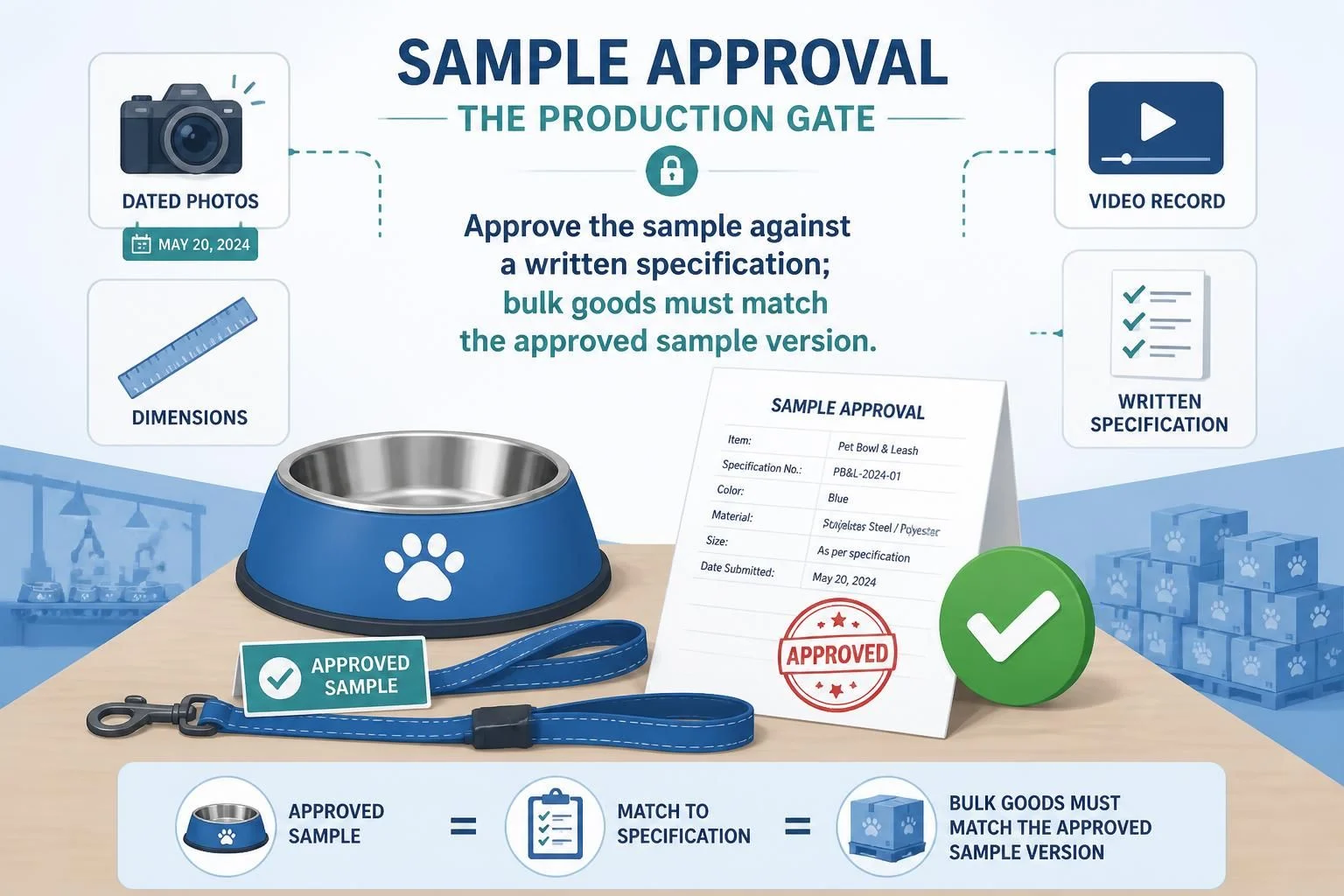
Why is sample approval the key production gate?
A sample reduces risk only when it is approved against a written specification and used as the reference for bulk production. A delivery term controls shipping responsibilities; it does not approve the product itself. Your sample record must therefore define the material, measurements, colour, finish, function, logo, packaging, labels, accessories, and any agreed tolerances.
| Sample check | Evidence to keep | Decision |
|---|---|---|
| Material and dimensions | Measurement record and dated photos | Approve or request revision |
| Function and assembly | Test notes or video | Approve or request revision |
| Branding and packaging | Artwork version and package photos | Approve or request revision |
| Compliance documents | Exact report and SKU/material match check | Accept, clarify, or obtain advice |
Keep the approved sample where practical. If you cannot, keep a complete photo and video record. Record every approved change. If the logo moves to avoid a seam, put that decision in the production file. The supplier and inspection team then work from one reference instead of several conflicting messages.
Copy this approval line into your order file: “Bulk goods must match the approved sample version [date/version], the attached specification, approved artwork, packaging file, and agreed inspection criteria. Any change requires written buyer approval before production.” Review the wording with your supplier and qualified adviser for the order and market involved.
Learn how to order product samples from China before paying a production deposit. A good sample is not a guarantee, but it is the clearest point to correct a product before you order at scale.
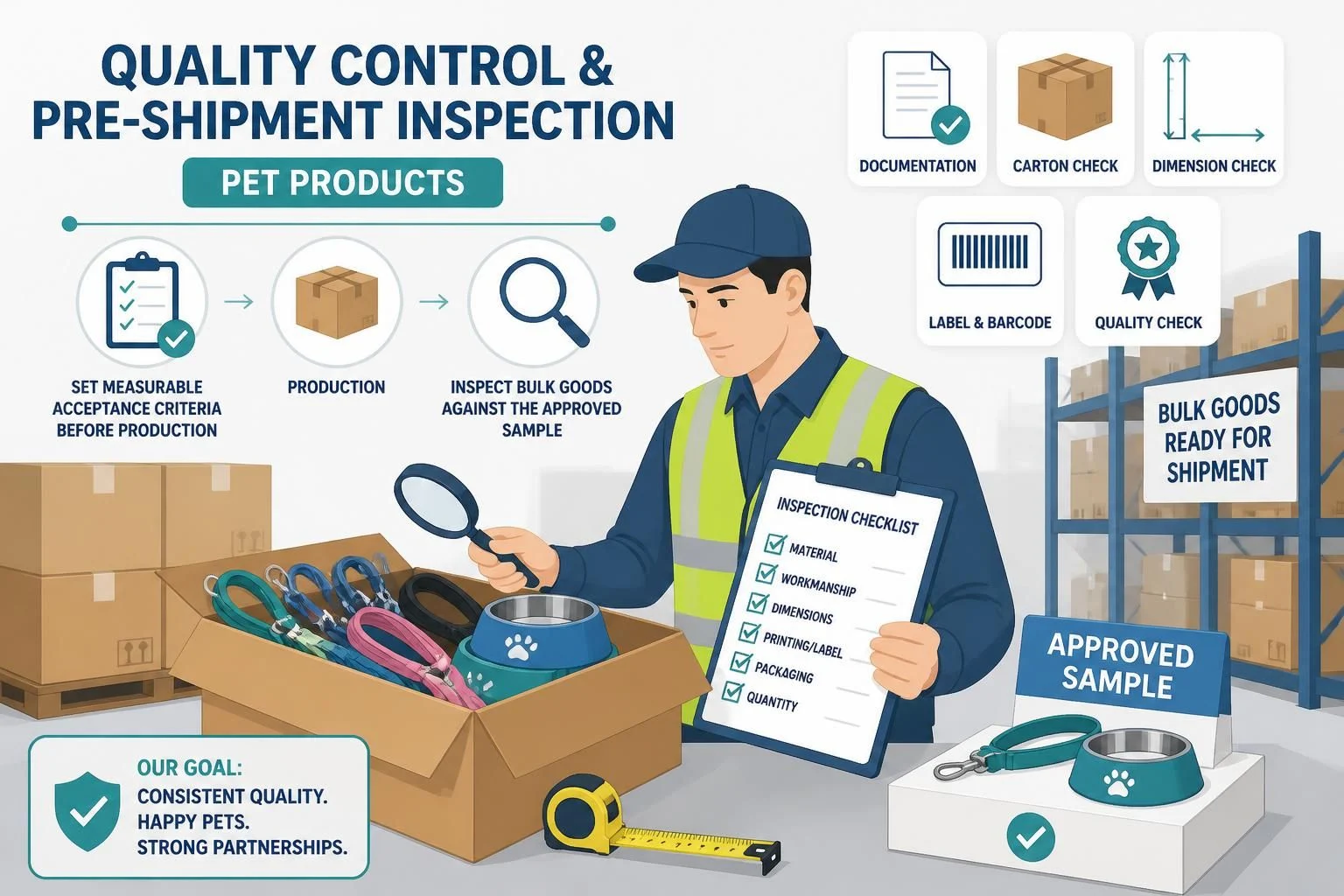
How do you set quality-control rules for pet products?
Set measurable acceptance criteria before production, because “good quality” cannot be inspected consistently. Your criteria should name the approved material, colour, dimensions, function, packaging, carton markings, quantity, and product-specific checks. An AQL sampling plan can help define how goods are sampled; it does not replace the requirements you want the product to meet.
Make the checks fit the product. For a leash, inspect webbing, hardware, stitching, dimensions, and label placement against the approved file. For a bowl, check finish, cracks, sharp edges, dimensions, and packaging. For an electronic feeder, verify operation, charging or cable accessories, labels, and packaging before cartons leave the supplier.
Use pre-shipment inspection when a supplier is new, the order is branded, the order value is significant, or a defect could affect safety or your reputation. Our China quality inspection guide explains the usual inspection workflow. Keep inspection criteria with the purchase order and approved sample, not only in the inspector’s notes.
How should you compare pet-product quotes from China?
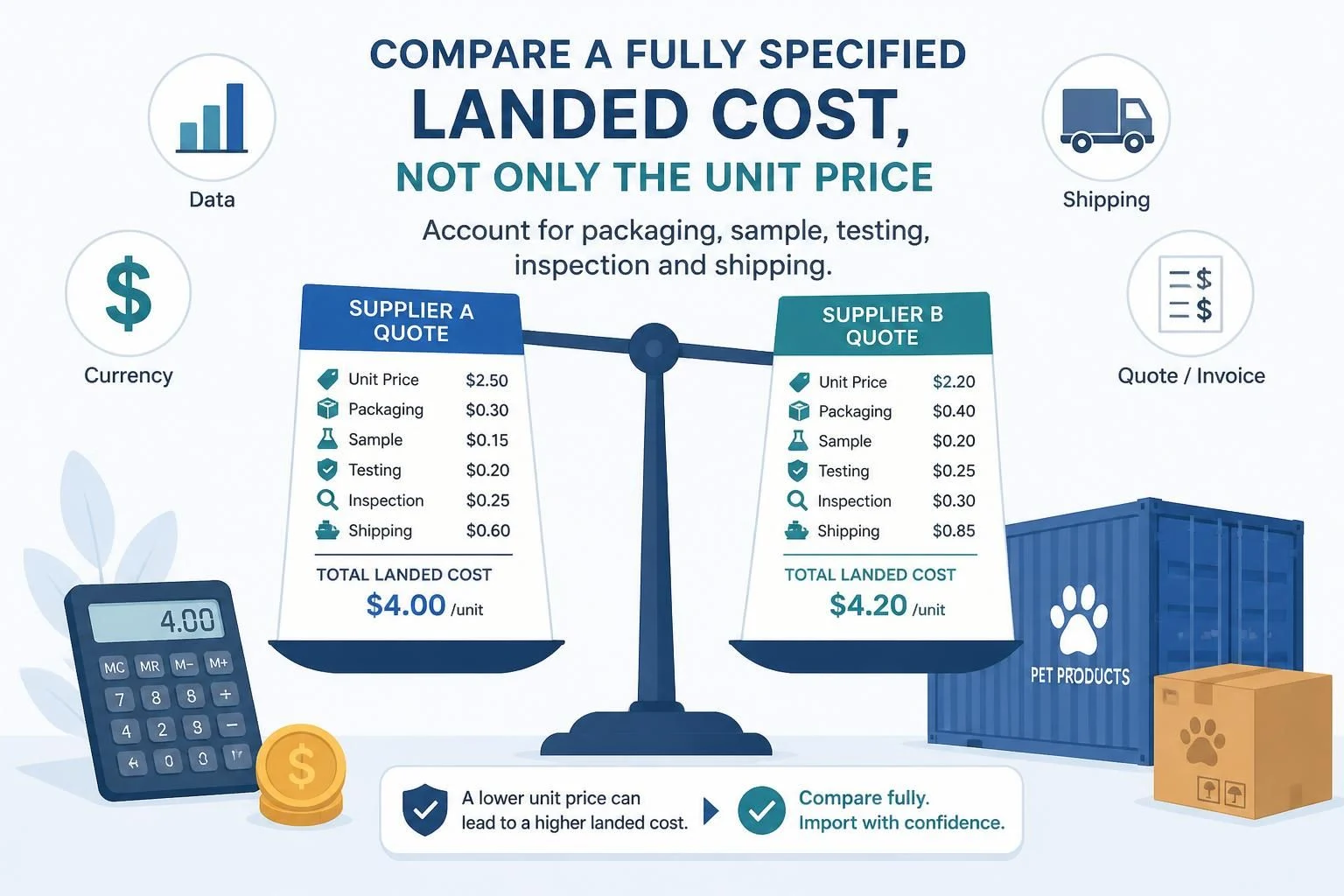
Compare a fully specified order cost rather than the lowest unit price. The delivery term you agree changes which party handles parts of transport, cost, and risk. A quote cannot be judged fairly until the SKU, packaging, sample/tooling charges, inspection, inland delivery, carton data, delivery term, and exclusions are visible.
- Legal entity, SKU/version, MOQ, unit price, currency, and production lead time
- Sample, tooling, logo, barcode, retail packaging, and master-carton costs
- Testing, inspection, domestic delivery, warehouse consolidation, and freight inputs
- Carton dimensions, gross weight, payment terms, Incoterm, and excluded charges
A cheaper item can cost more once fragile packaging, multiple-supplier consolidation, testing, or shipping are included. Use the Incoterms 2020 responsibilities guide to discuss the agreed term, then ask a qualified freight partner for a shipment-specific cost plan. Do not assume that an attractive DDP offer removes every importer responsibility.
When should you use a China sourcing agent for pet products?
A sourcing agent is most useful when you need local supplier comparison, Chinese-language document checks, sample coordination, multi-supplier consolidation, inspection, or export coordination. Confirm Greentime’s current service scope, experience claims, and available services directly with the team before you make a purchasing decision.
Consider support for a first bulk order, a private-label SKU, a compliance-sensitive product, or an order combining products from several suppliers. A practical process is brief, shortlist, comparable quotes, samples, supplier checks, QC plan, inspection, consolidation, and shipping. You stay responsible for the product and market decision; a local team helps gather and verify the order evidence.

Need help sourcing pet accessories from China?
Send your product list, estimated quantity, and destination country. We can help compare suppliers, arrange samples, define quality checks, consolidate orders, and plan shipping.
Frequently asked questions
Are pet products from China safe to import?
Origin alone does not determine safety. Requirements depend on the final product, materials, intended use, claims, and selling market. Define those points, confirm the applicable rules with qualified sources, review relevant test evidence, and set QC criteria for the final SKU before you approve production or shipment.
What certifications do pet products need?
There is no one certificate for every pet product. Requirements can vary by product type, components, materials, product claims, and selling market. For example, food-contact use, electrical components, wireless functions, and chemical restrictions require different questions. Ask the relevant regulator or a qualified laboratory about your exact final SKU.
How do I find a reliable pet product supplier in China?
Compare several suppliers against one product brief. Verify the legal entity and payment recipient, ask for product-capability evidence, approve a sample, document commercial terms, and agree inspection criteria. A marketplace listing, business card, or factory photo can help screening, but none independently approves a supplier for your order.
What is the MOQ for private-label pet products?
MOQ depends on the SKU, material, logo method, packaging, tooling, supplier schedule, and whether you use a stock item or a custom version. Ask suppliers for both a stock-product MOQ and a custom-production MOQ, then compare them with sample cost, packaging charges, and the full landed-cost plan.
Should I inspect pet products before shipment?
Inspection is particularly useful for a new supplier, branded products, higher-value orders, or products where defects could create safety or reputation problems. Agree what will be inspected before production. Use the approved sample, specification, packaging file, and measurable acceptance criteria as the inspector’s reference.
Start with a product brief, not a product listing
Use a clear sequence: specify the SKU, shortlist suppliers, check the business and product evidence, approve a sample, confirm the market requirements and QC criteria, compare landed cost, then inspect before shipping. This takes more work than choosing the cheapest listing. It gives you a better basis for placing the order.
If you need help comparing pet-accessory suppliers, coordinating samples, setting an inspection plan, or arranging shipping, use the quote button above. Share the product list, expected quantity, and destination country so the conversation starts with the details that matter.
How this guide handles safety and sourcing claims
This guide separates supplier screening, sample approval, product testing, quality inspection, and shipping because each step answers a different question. It does not certify a product, approve a supplier, or replace legal advice. Before publication, a qualified reviewer should confirm any claim about a specific product, component, selling market, or test method against current primary sources.

Gong Zheng is a blog editor for Greentime, focusing on global sourcing, wholesale market trends, and practical advice for international buyers. Drawing on extensive experience in digital marketing and cross-border trade, he shares expert insights to help small and medium-sized enterprises source products more efficiently and avoid common pitfalls. Passionate about connecting buyers with reliable suppliers, he writes in a clear, approachable style that makes complex topics easy to understand.