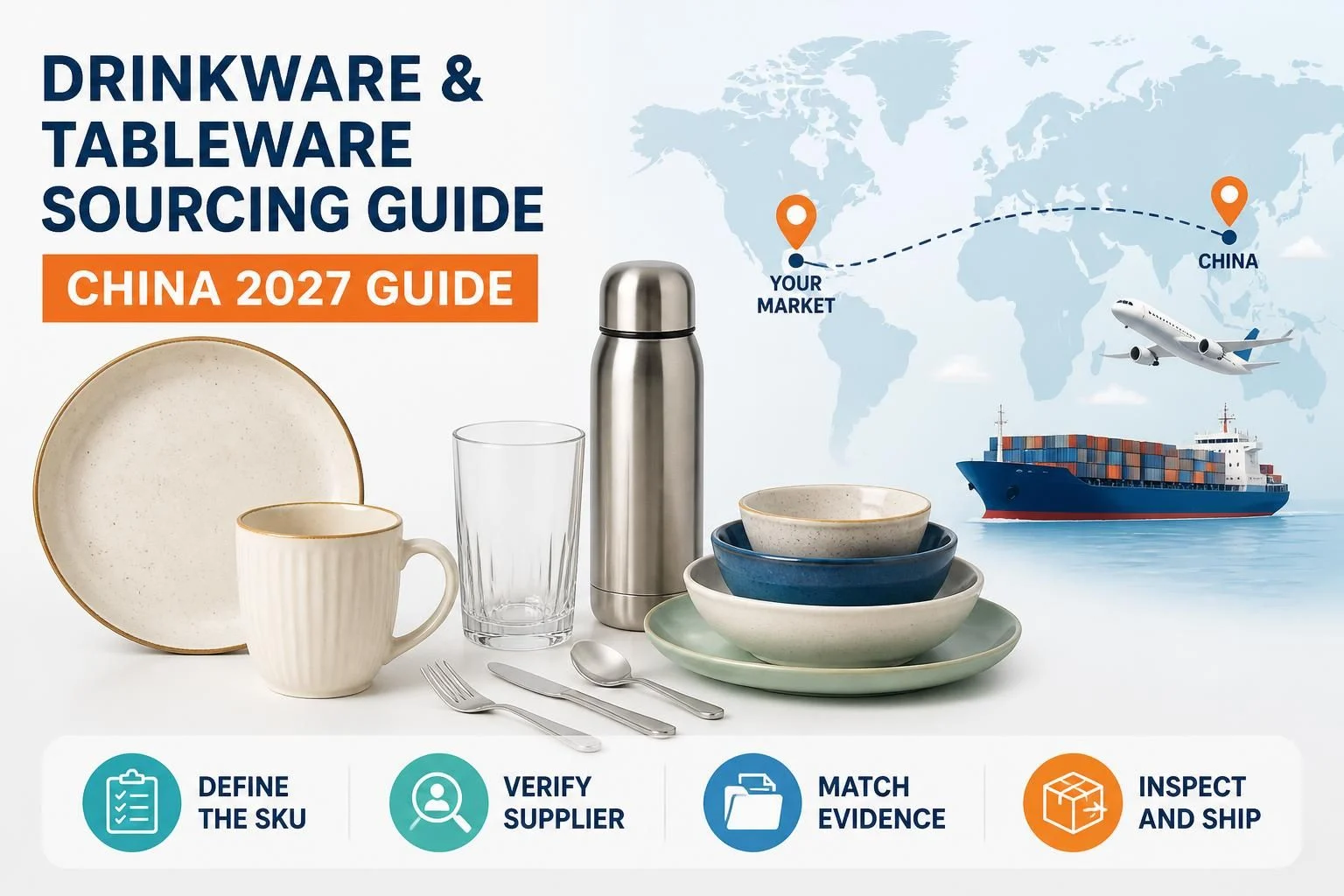
Start with a written SKU specification, destination market, and packaging plan. A product photo, target price, or “food grade” claim cannot tell you whether two suppliers are quoting the same item. Approve a production sample, define inspection criteria, and calculate landed cost before releasing the order.
The guide covers ceramic and porcelain tableware, glassware, stainless steel drinkware, vacuum bottles, cutlery, and mixed sets. The kitchenware wholesale page lists the product families available through Greentime.
Key Takeaways
- Define material, dimensions, capacity, food-contact use, destination market, packaging, and quantity before requesting prices.
- Verify the supplier, approve a measurable sample, and retain it as the production reference.
- Food-contact evidence must match the final SKU, material, intended use, test method, and selling market.
- Compare sellable landed cost, including packaging, breakage controls, inspection, freight, duties, and delivery.
Drinkware and tableware product types to consider
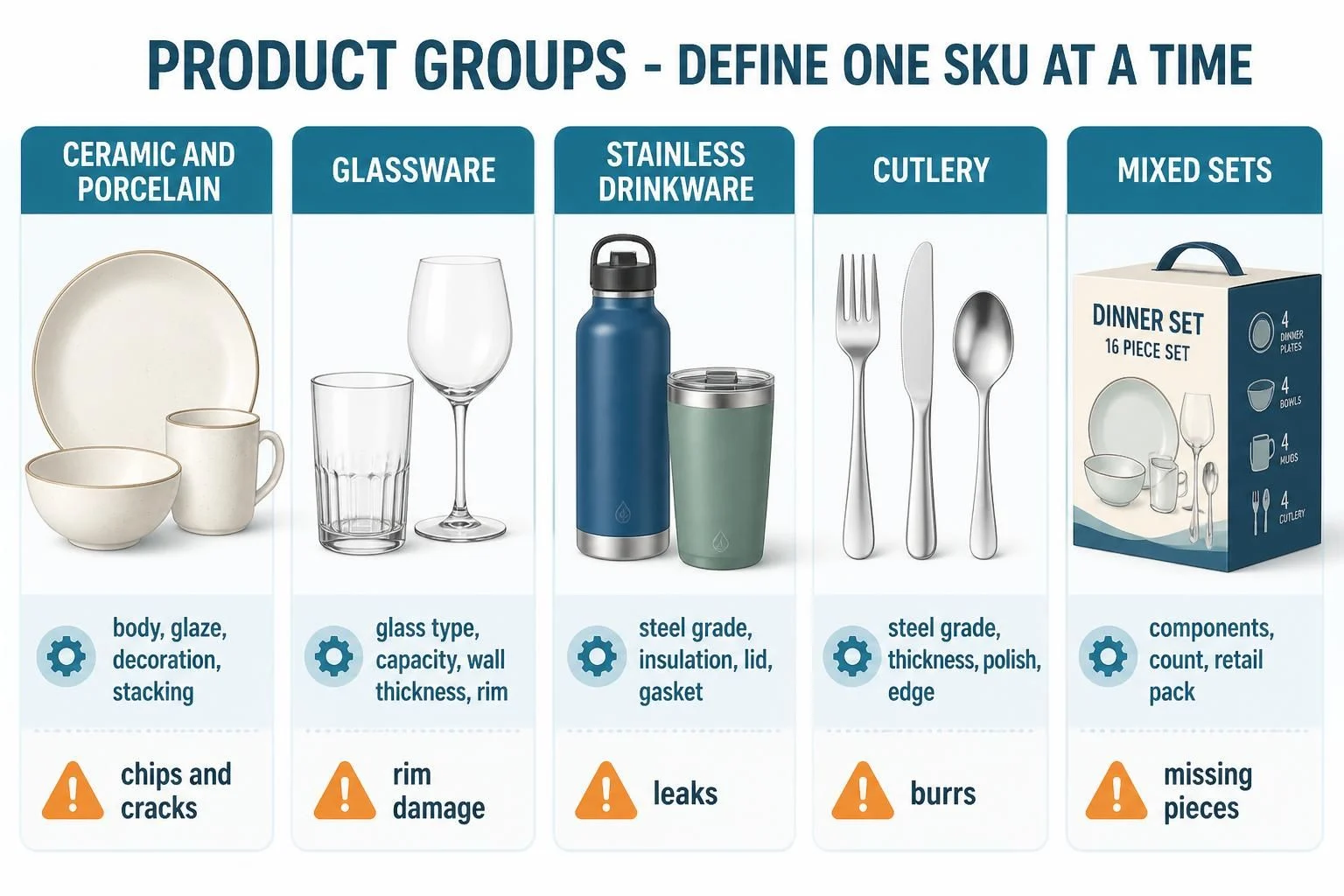
Common product groups include ceramic and porcelain dinnerware, glassware, stainless steel drinkware, vacuum bottles, tumblers, mugs, cutlery, plastic or melamine items, bamboo products, and hospitality sets. Choose a specific product and intended use first. Material, capacity, finish, destination, and packaging then shape the supplier questions.
Define one SKU at a time. Record dimensions, capacity, unit weight, wall or base thickness, finish, color, decoration, handle or lid, and any heat, dishwasher, leak, or insulation claim. A stock mug and a private-label double-wall tumbler may look similar in a catalog, but they need different samples, packaging, and checks.
| Product group | Fields to define | Common issue to control |
|---|---|---|
| Ceramic or porcelain | Clay or body, dimensions, glaze, decoration, weight, stacking | Chips, cracks, glaze variation, wobble, breakage |
| Glassware | Glass type, capacity, wall thickness, rim, decoration, packing | Rim damage, cracks, thermal shock, carton failure |
| Stainless drinkware | Steel grade, capacity, insulation, lid, gasket, finish | Leaks, wrong capacity, scratches, unsupported claims |
| Cutlery | Steel grade, thickness, polish, edge, set count | Burrs, weak joints, mixed pieces, finish mismatch |
| Mixed sets | Components, count, retail pack, carton quantity | Missing pieces, wrong labels, mixed SKUs |
Product rule: ask whether a supplier can make your exact item in the required material, finish, packaging, and market specification. “Can you make tableware?” is too broad to qualify a supplier or compare a quote.
Choose standard stock when you need speed and a small test order. Choose OEM or private label when you need a specific color, logo, shape, mold, retail pack, or set composition. Put every custom element in the brief. Otherwise, the first sample may quietly become a negotiation over what you thought was included.
How do you source drinkware and tableware from China?
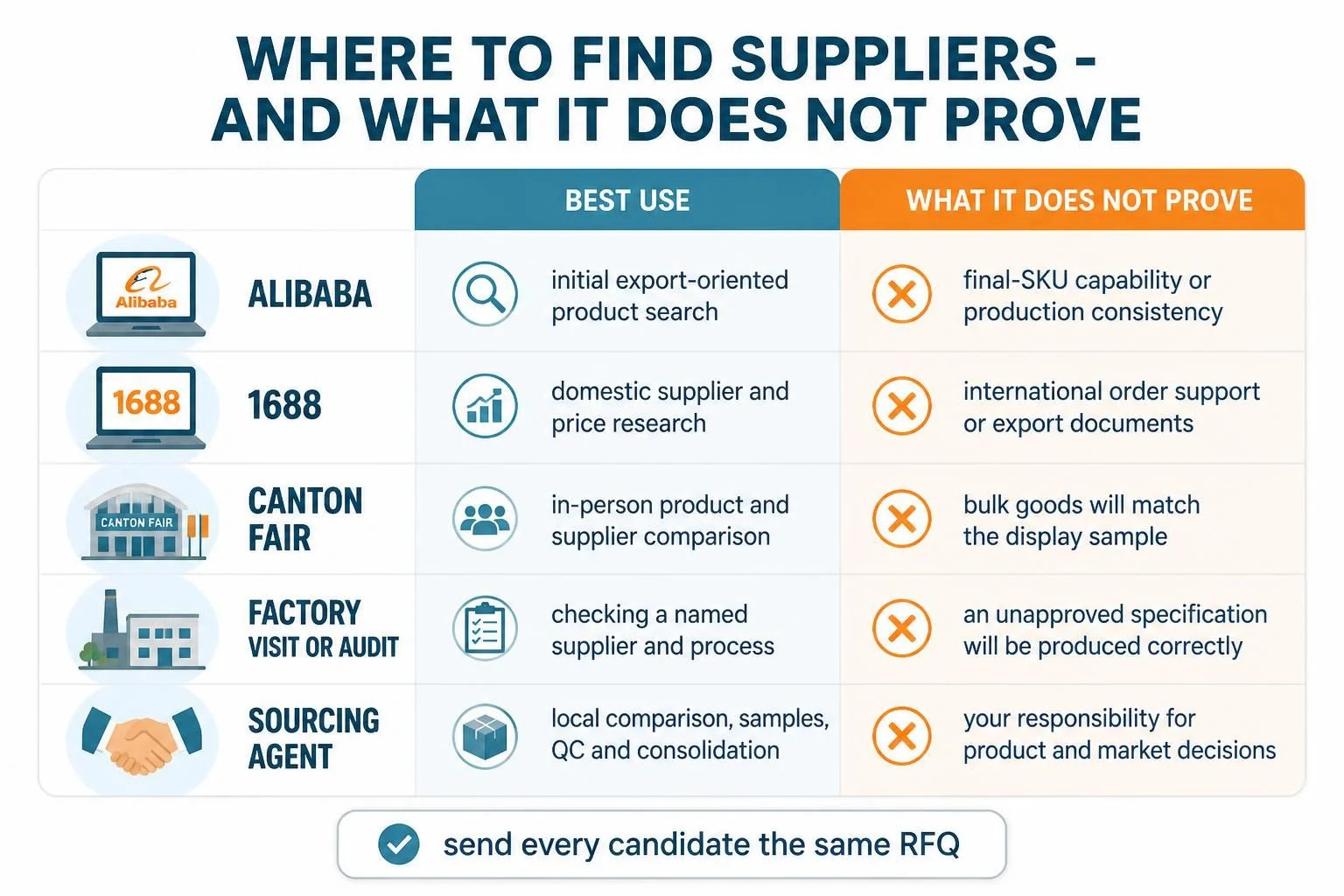
Alibaba, 1688, the Canton Fair, specialist trade fairs, factory referrals, regional sourcing offices, and sourcing agents can help you find candidates. None confirms that a supplier can make your SKU consistently or that its payment and export details are in order. Verify those points before placing an order.
| Channel | Best use | What it does not prove |
|---|---|---|
| Alibaba | Initial export-oriented product search | Final-SKU capability or production consistency |
| 1688 | Domestic supplier and price research | International order support or export documents |
| Canton Fair | In-person product and supplier comparison | Bulk goods will match the display sample |
| Factory visit or audit | Checking a named supplier and process | An unapproved specification will be produced correctly |
| Sourcing agent | Local comparison, samples, QC, and consolidation | Your responsibility for product and market decisions |
Shortlist several candidates and send each the same RFQ. Request the legal company name, product role, comparable product records, materials, MOQ, sample route, production schedule, carton data, export experience, and payment details. Keep the answers in one comparison sheet. Differences are easier to spot there than across chat threads.
A factory may fit repeat production, custom tooling, or a focused SKU. A trading company may be more practical for a mixed collection. In either case, verify the legal entity, product role, payment beneficiary, and QC responsibility. See the guide to verifying a Chinese supplier before contacting candidates.
What should your drinkware and tableware RFQ include?
Send every supplier the same written specification and quantity breaks. A photograph shows the shape, but leaves material grade, capacity tolerance, decoration, packaging, destination, and required evidence open to interpretation.
- SKU name, reference image, drawing, intended use, and selling market
- Material, grade, dimensions, tolerances, weight, capacity, wall or base thickness
- Finish, glaze, color reference, decoration, logo method, and artwork version
- Lid, handle, seal, gasket, set components, dishwasher, microwave, heat, leak, or insulation claims
- Individual packaging, inner box, export carton, carton quantity, barcode, and shipping marks
- Target quantity, quantity tiers, MOQ, sample cost, tooling, production lead time, and requested Incoterm
- Required test evidence, sample approval route, inspection criteria, and change-notification rule
Specify the material in enough detail to compare offers. For stainless steel, state grade, thickness, finish, and intended use. Do the same for ceramic body, glass type, plastic, silicone, wood, glaze, inks, and coatings. Ask suppliers to identify any requirement they cannot meet.
| RFQ field | Why it matters | Sample evidence |
|---|---|---|
| Material and grade | Changes performance, price, and evidence | Declaration, measurement, or report |
| Capacity and dimensions | Changes buyer use, carton fit, and returns | Measured sample record |
| Decoration and color | Changes tooling, rejects, and repeatability | Approved artwork and photos |
| Packaging and carton | Changes breakage, freight, and sellable units | Pack-out photos and carton data |
| Market and claims | Determines evidence and labels | Market-specific review |
RFQ test: if two suppliers can read your file and quote different materials, dimensions, or packaging, the brief is not ready. Add the missing fields before comparing unit prices.
For a branded range, include the logo location, artwork file version, retail packaging, barcode, and approval owner. For fragile products, state dividers, inner boxes, carton strength, palletization, and any drop expectation. For food-contact products, identify the intended use and market before requesting reports. A document for another SKU is not evidence for yours.
Verify suppliers before paying a deposit
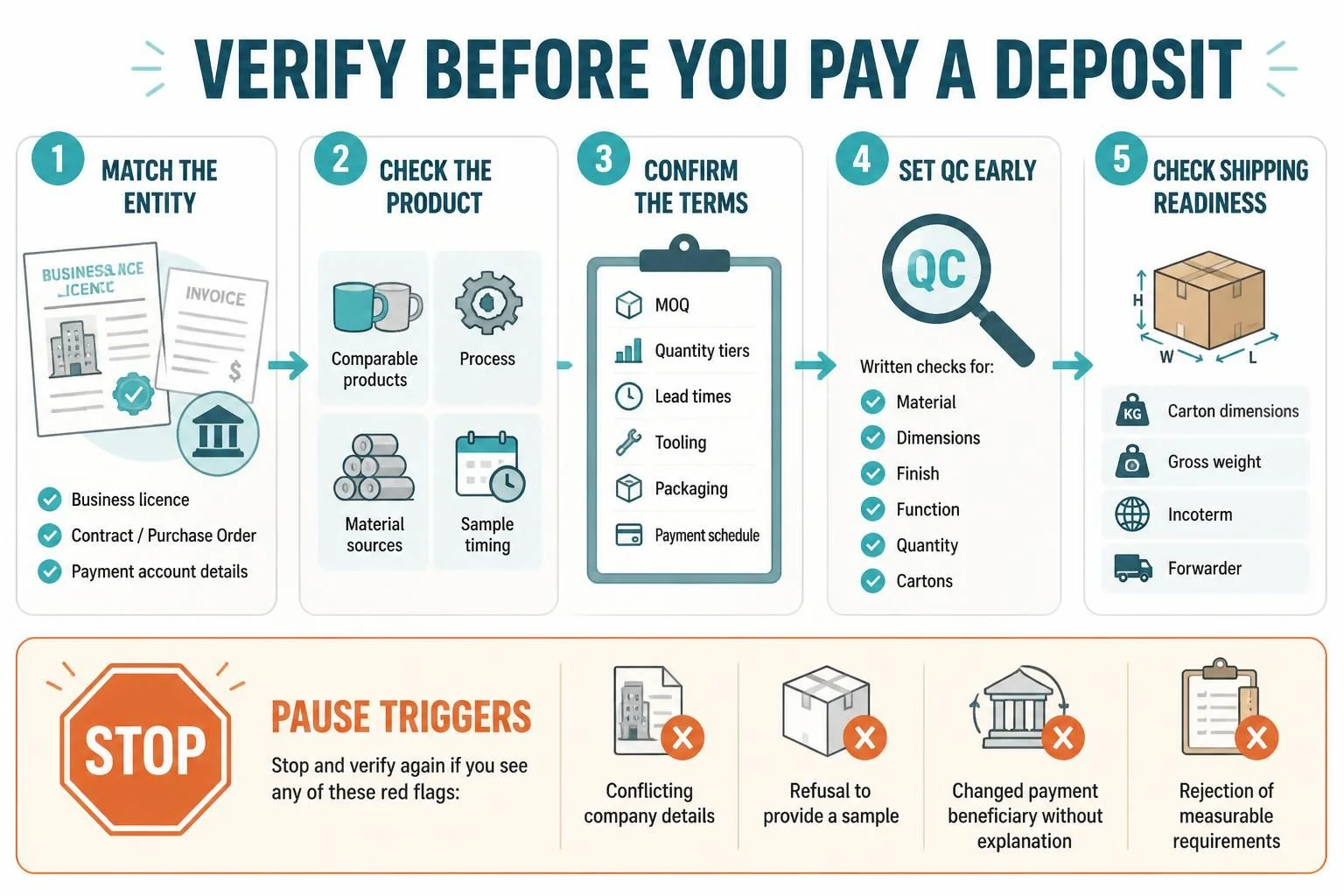
Check the legal entity, production role, product capability, payment beneficiary, sample process, and QC arrangements as separate items. A business licence or marketplace badge helps with screening; neither proves that the supplier can reproduce your approved SKU. Keep the supporting records with the quotation and purchase order.
- Match the entity: compare the registered name and address on the licence, quotation, invoice, contract, and payment account.
- Check the product: ask for comparable products, process information, material sources, sample timing, and packaging capability.
- Confirm the terms: record MOQ, quantity tiers, sample and production lead times, tooling, packaging, domestic delivery, and payment schedule.
- Set QC early: require written checks for material, dimensions, finish, function, quantity, documents, packaging, and cartons.
- Check shipping readiness: request carton dimensions, gross weight, agreed Incoterm, and export information for the forwarder.
Pause when company details conflict, a supplier refuses a sample, the payment beneficiary changes without a written explanation, or the supplier rejects measurable requirements. One mismatch may have a reasonable explanation. Several unresolved mismatches are a reason to stop before sending money.
A product sourcing service can help with local shortlisting, Chinese-language checks, sample coordination, and quote comparison. You still need to approve the final product, evidence, commercial terms, and selling-market requirements.
What food-contact and product-safety evidence should you check?
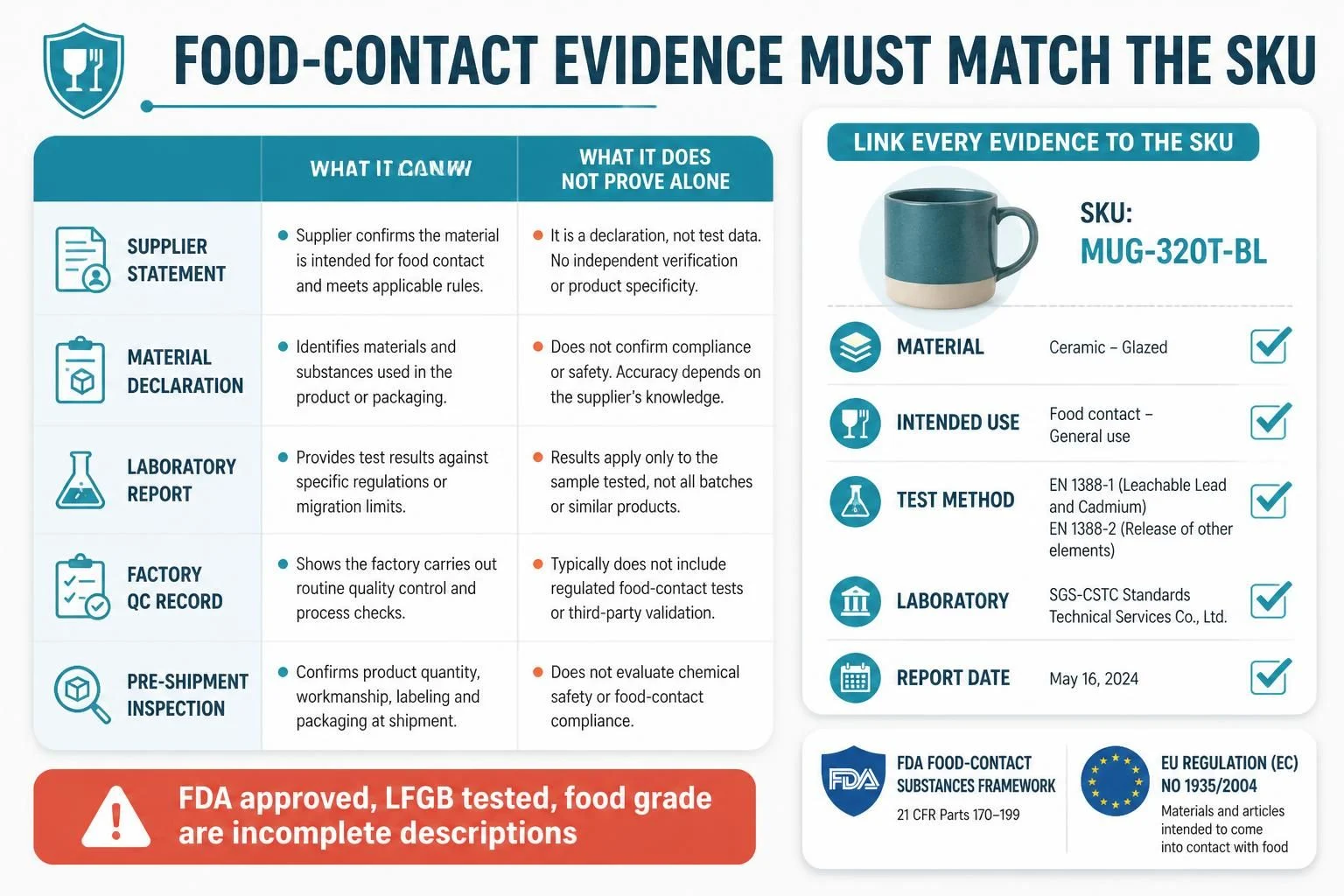
Food-contact evidence should match the final SKU, material, intended use, destination market, test method, laboratory, and report date. The FDA’s Packaging & Food Contact Substances page (FDA, 2024) explains that the agency regulates substances that come into contact with food, including substances used in cookware and food containers. This framework is not blanket FDA approval of a finished glass, mug, plate, bottle, or cutlery set.
For the EU, the European Commission’s food-contact materials overview describes the framework for articles such as kitchenware and tableware. Its legal basis includes Regulation (EC) No 1935/2004 (European Parliament and Council, 2004), with material-specific measures where applicable. For plastic food-contact materials, review Regulation (EU) No 10/2011 (European Commission, 2011) and its current amendments. Check UK, Australian, Canadian, and other destination rules separately.
| Evidence type | What it can show | What it does not prove alone |
|---|---|---|
| Supplier statement | What the supplier says about material or use | Independent conformity or production consistency |
| Material declaration | Declared composition or components | Finished-product performance or current batch |
| Laboratory report | Results for the tested sample and method | A different SKU, decoration, component, or market |
| Factory QC record | Checks recorded during production | Independent verification or legal compliance |
| Pre-shipment inspection | Product, quantity, appearance, and packing at inspection | Every market-specific regulatory requirement |
- Ceramic and glass: review body, glaze, decoration, intended use, and relevant migration or thermal questions.
- Metal: confirm alloy, finish, intended food contact, and applicable composition or migration questions.
- Plastic, silicone, and seals: confirm material, food-contact use, temperature claim, colorants, and market rules.
- Wood and bamboo: identify treatment, finish, intended use, and destination-market requirements.
Evidence check: “FDA approved,” “LFGB tested,” “CE certified,” and “food grade” are incomplete descriptions. Ask which SKU, material, intended use, market, test method, laboratory, and report version the supplier means.
Do not copy a report from a similar product. A change in glaze, colorant, lid, gasket, decoration, coating, or intended use can change the evidence question. This article provides general sourcing information, not legal or testing advice. Confirm the applicable requirement with the destination regulator, accredited laboratory, or qualified compliance adviser before commercial import.
How do you approve samples and prevent breakage?
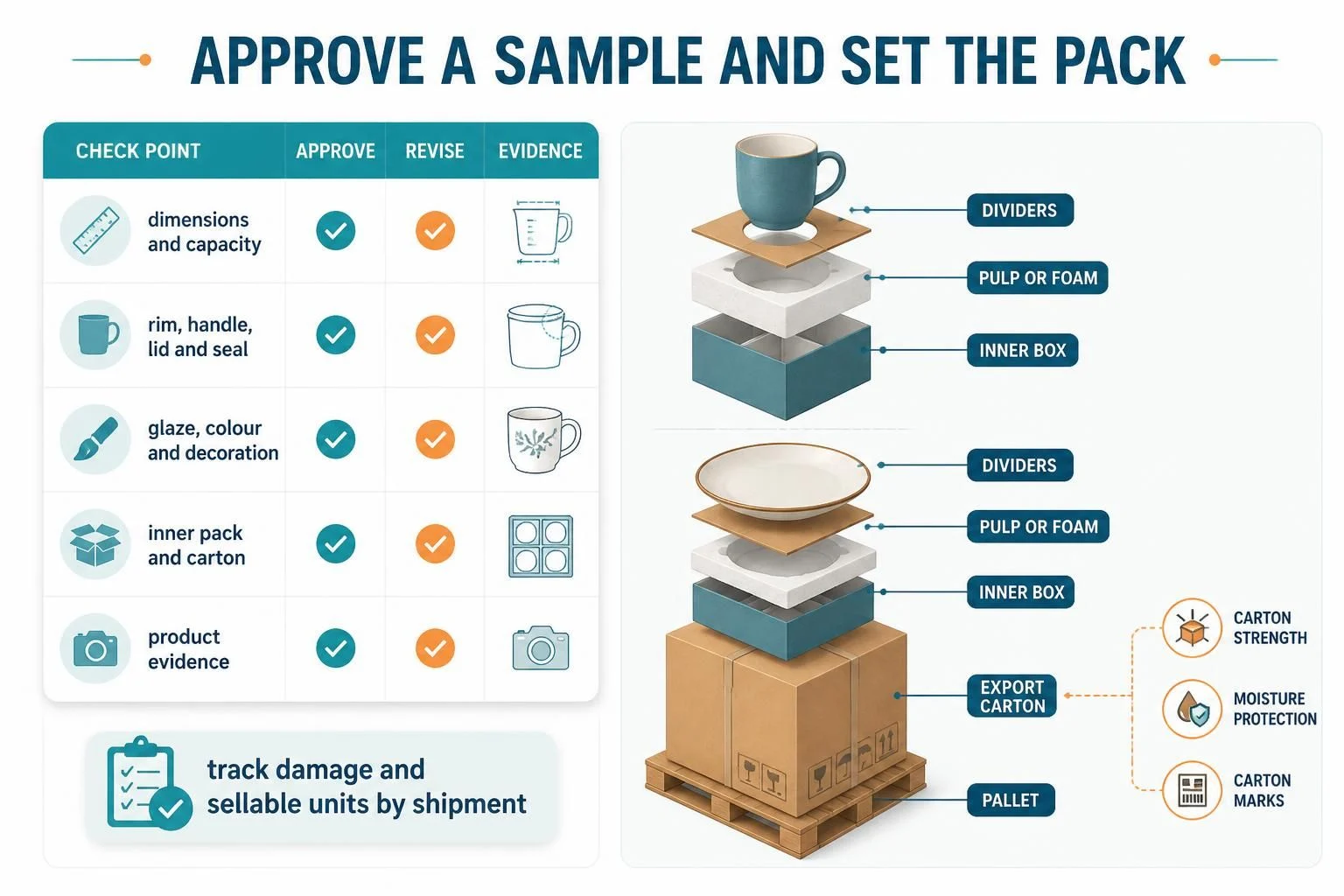
Approve a production sample against written criteria and keep that sample as the reference for bulk inspection. Check material, dimensions, capacity, finish, decoration, function, packaging, and labels. A showroom sample may demonstrate the design, but it may not match the materials or pack-out proposed for your order.
| Sample check | Evidence to keep | Decision |
|---|---|---|
| Dimensions, capacity, weight | Measurement record and dated photos | Approve or revise |
| Rim, handle, lid, seal, and function | Test note or video | Approve or revise |
| Glaze, color, logo, and decoration | Artwork version and photos | Approve or revise |
| Inner pack and carton | Pack-out photos and carton data | Approve or revise |
| Product evidence | SKU/material/report match review | Accept, clarify, or obtain advice |
For glasses and ceramics, check chips, cracks, rim finish, wobble, glaze coverage, color variation, stacking, and carton protection. For tumblers and bottles, check capacity, leaks, lid fit, gasket placement, insulation claims, and surface finish. For cutlery, check set count, burrs, polish, joints, and retail-pack accuracy.
Illustrative SKU review: for a private-label ceramic mug, compare the quote, approved sample, food-contact documents, artwork, unit box, and export carton against one SKU sheet. Record the mug’s agreed dimensions and capacity tolerances, glaze/color reference, logo position, pack-out, and inspection checks there. If a quote or report describes a different material, decoration, or intended use, resolve the mismatch before approving the sample. This is a workflow example, not a report of a Greentime order.
Set the unit pack before production. Specify dividers, pulp or foam protection, inner boxes, carton strength, palletization, moisture protection, carton marks, and any spare-unit allowance. Ask the supplier to keep the approved pack-out on reorders. Track damage and sellable units by shipment; use those records to judge whether a packaging change offsets its added cost.Order-file check: record the approved sample version, specification, artwork, packaging file, and inspection criteria in the purchase order. Require written approval before changes. Have transaction wording checked for your market.
Use the OEM and private-label service when your collection needs custom decoration, packaging, molds, or repeat artwork control. The approved sample gives both sides a reference for bulk production, though inspection is still needed to check consistency.
What should pre-shipment drinkware and tableware QC cover?
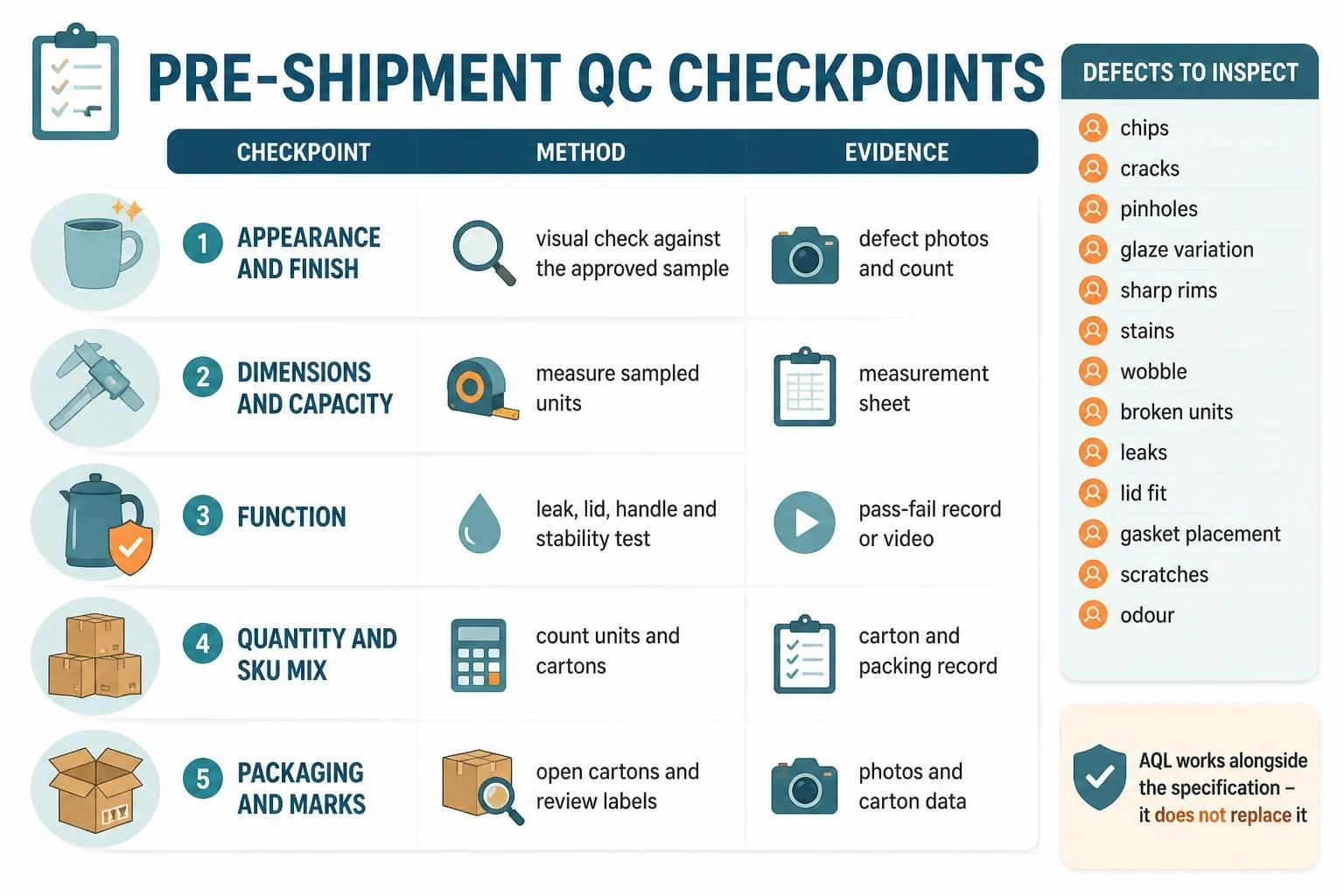
Before shipment, check the goods, function, appearance, quantity, documents, and packaging against the approved order file. Put product requirements and defect classes in the specification. If you use AQL sampling, agree the standard, lot size, inspection level, defect classes, and acceptance numbers with the supplier or inspector before production. The sampling plan works alongside the specification; it does not replace it.
| Checkpoint | Method | Evidence |
|---|---|---|
| Appearance and finish | Visual check against approved sample | Defect photos and count |
| Dimensions and capacity | Measure sampled units | Measurement sheet |
| Function | Leak, lid, handle, stability, or set test | Pass/fail record or video |
| Quantity and SKU mix | Count units and cartons | Carton and packing record |
| Packaging and marks | Open cartons and review labels | Photos and carton data |
For ceramic or glass products, inspect chips, cracks, pinholes, glaze variation, sharp rims, stains, wobble, and broken units. For drinkware, add leaks, lid fit, gasket placement, capacity, scratches, odor, and the required performance claim. For mixed sets, confirm every component, barcode, carton quantity, and retail label.
Use in-process checks when decoration, glaze, assembly, or packing creates a high defect risk. Use final random inspection before balance payment or shipment release when independent confirmation matters. Review the quality inspection service and the China quality inspection process for a wider inspection framework.
How do you compare packaging, freight, MOQ, and landed cost?
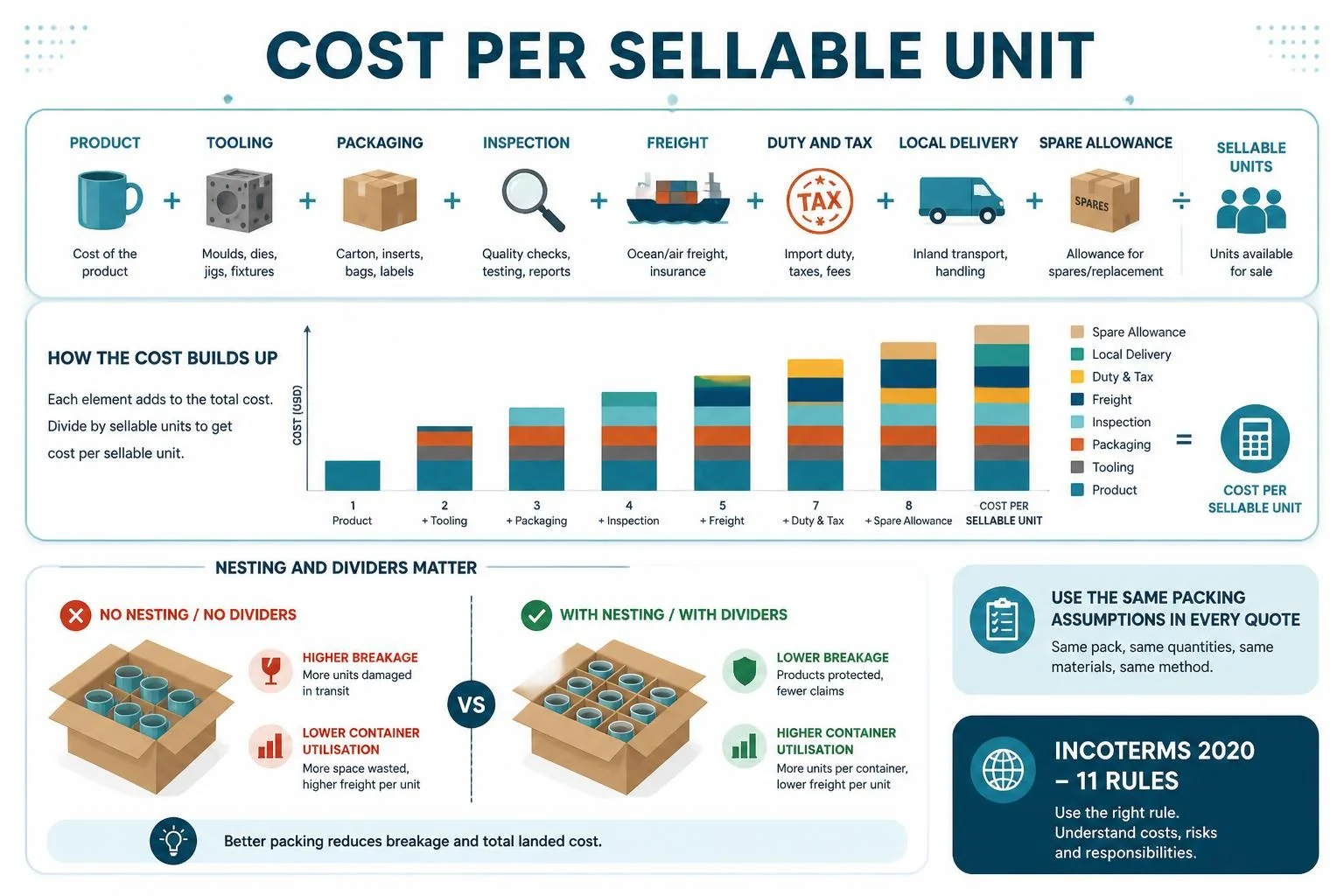
Compare landed cost per sellable unit using the same quantity, packaging, destination, and Incoterm. The quoted unit price is only one part of the order. Include samples, tooling, decoration, packaging, cartons, inspection, inland transport, consolidation, freight, insurance, duties, customs clearance, delivery, and any agreed breakage allowance.
Calculate cost per sellable unit as (product + tooling + packaging + inspection + freight + duty/tax + local delivery + approved spare allowance) ÷ sellable units. Label examples as illustrative. Publish an average China price only when internal data supports it and identifies the period, SKU, quantity, included costs, destination, and Incoterm.
Packaging changes both breakage and freight. Nesting, dividers, inner boxes, carton dimensions, palletization, and container utilization can change the number of sellable units you receive. Use the same packing assumptions in every quote. The ICC Incoterms® rules clarify seller and buyer tasks, costs, and risks. ICC’s current page lists 11 rules in Incoterms® 2020 (ICC, accessed 2026). Check the edition named in your contract and confirm the cost breakdown with your freight provider. Read our Incoterms responsibilities guide for a buyer overview.
For reorders, keep the current SKU sheet, approved sample, packaging file, inspection criteria, and change-approval rule together. Require notice before the supplier changes materials, glaze, lids, gaskets, decoration, cartons, or subcontractors. For multi-factory orders or fragile cartons, review the shipping and freight forwarding service options.
When should you use a China sourcing agent?
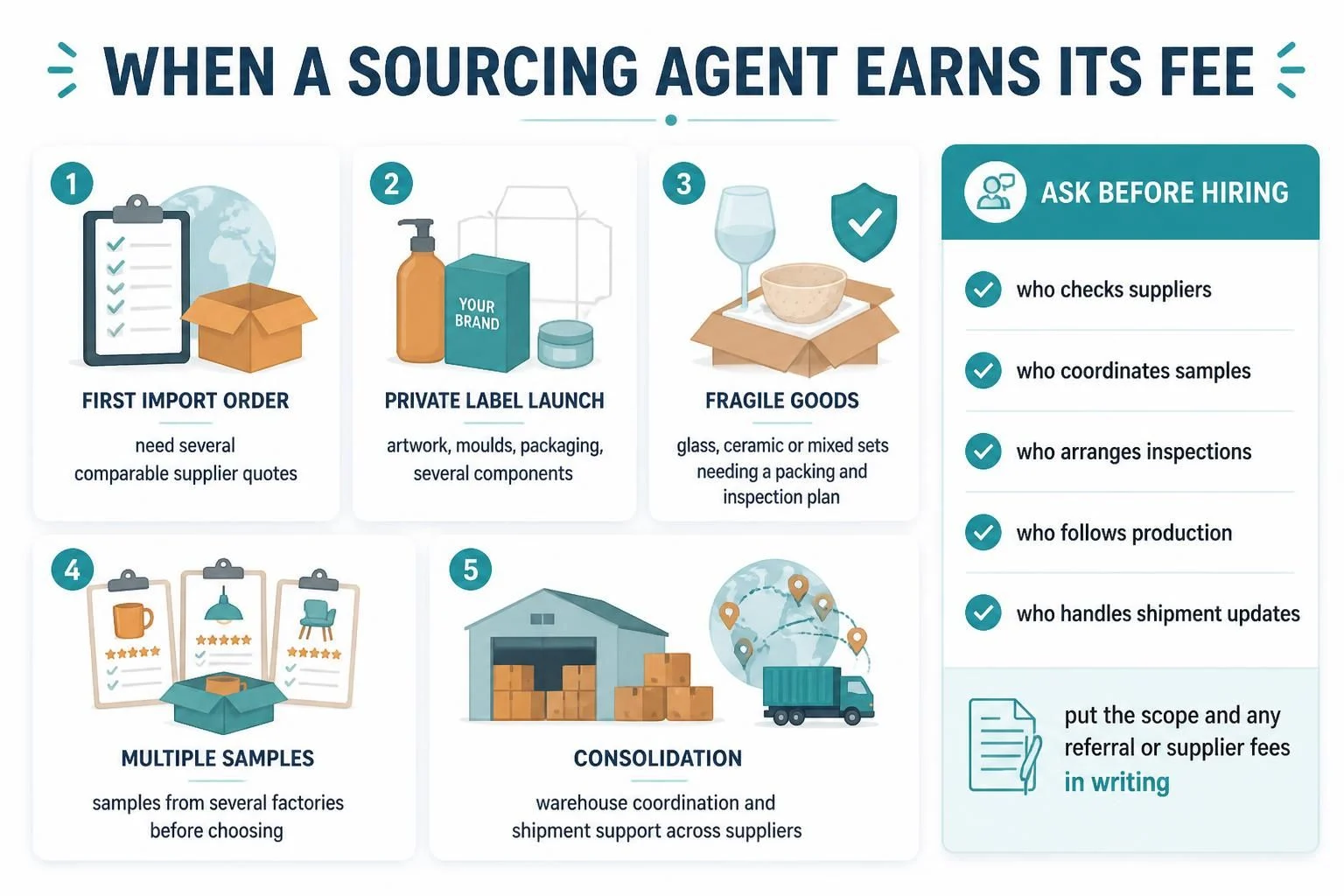
A sourcing agent is most useful when supplier checks, Chinese-language communication, sample coordination, fragile packaging, product-specific QC, mixed-SKU consolidation, or shipping support exceed your internal capacity. The decision should follow the order requirements, not a claim that an agent is always cheaper.
- You are placing your first import order and need several comparable supplier quotes.
- You are launching private-label products with artwork, molds, packaging, or several components.
- You are buying fragile glass, ceramic, or mixed sets and need a packing and inspection plan.
- You need samples from multiple factories before choosing a final supplier.
- You need consolidation, warehouse coordination, or shipment support across multiple suppliers.
Before hiring an agent, ask what it will do and what it will charge. Confirm who checks suppliers, coordinates samples, arranges inspections, follows production, and handles shipment updates. Put the scope and any referral or supplier fees in writing.
Frequently Asked Questions
Is drinkware and tableware from China safe to import?
Safety depends on the final SKU, material, intended use, destination rules, packaging, and supporting evidence. The FDA and European Commission describe food-contact frameworks, but neither is a blanket approval for every finished product. Match the report to the SKU, material, method, market, and date before commercial import.
What certificates do I need for China glassware or ceramics?
There is no universal certificate for all glassware or ceramics. Requirements depend on the material, glaze or decoration, intended food contact, product claims, and destination market. Ask for the exact declaration or laboratory report and have a qualified laboratory or compliance adviser confirm whether it covers your final product.
What is a realistic MOQ for drinkware suppliers?
MOQ varies by stock status, material, decoration, tooling, packaging, color, and quantity. Do not treat one supplier’s MOQ as a category average. Ask every shortlisted supplier to quote the same specification at buyer selected quantities, then compare the effect on unit price, inventory, breakage allowance, and freight.
How do I prevent breakage in an import order?
Approve unit packaging, dividers, inner boxes, carton strength, palletization, carton marks, and any drop expectation before production. Inspect the pack-out during production or before shipment, and calculate landed cost by sellable units. A stronger carton adds cost, so compare that change with recorded damage and sellable-unit counts.
Should I buy from a factory or a trading company?
Choose based on SKU complexity, repeat volume, customization, mixed-SKU needs, evidence, QC, and consolidation. A factory may fit repeat OEM production. A capable trading company may fit a mixed collection. Verify the legal entity, product role, payment beneficiary, sample route, and QC responsibility either way.
Should I use a sourcing agent for drinkware and tableware?
Consider an agent when you need supplier checks, several comparable quotes, sample coordination, fragile packaging controls, independent QC, mixed-SKU consolidation, or shipping support. Ask for a clear scope and fee structure. You remain responsible for approving the product, evidence, commercial terms, and destination-market requirements.
Make the first shipment a controlled test
Before contacting suppliers, define the SKU and destination market. Then compare candidates against the same RFQ, approve a sample, confirm the pack-out, and inspect the bulk order before release. Calculate landed cost by sellable unit and keep the approved files together for the next order.
Need help sourcing drinkware or tableware from China? Get a free quote in 24 hours from the Greentime team. Confirm product-specific compliance requirements with the relevant regulator, accredited laboratory, or qualified adviser before commercial import.

Gong Zheng is a blog editor for Greentime, focusing on global sourcing, wholesale market trends, and practical advice for international buyers. Drawing on extensive experience in digital marketing and cross-border trade, he shares expert insights to help small and medium-sized enterprises source products more efficiently and avoid common pitfalls. Passionate about connecting buyers with reliable suppliers, he writes in a clear, approachable style that makes complex topics easy to understand.