Sourcing cookware from China can give you more material, finish, and packaging options than a simple marketplace search. It can also expose you to warped bases, weak handles, coating defects, missing documentation, and quotes that are impossible to compare. This China cookware sourcing guide shows you how to define the product, shortlist suppliers, compare landed cost, approve samples, and inspect the order before shipment.
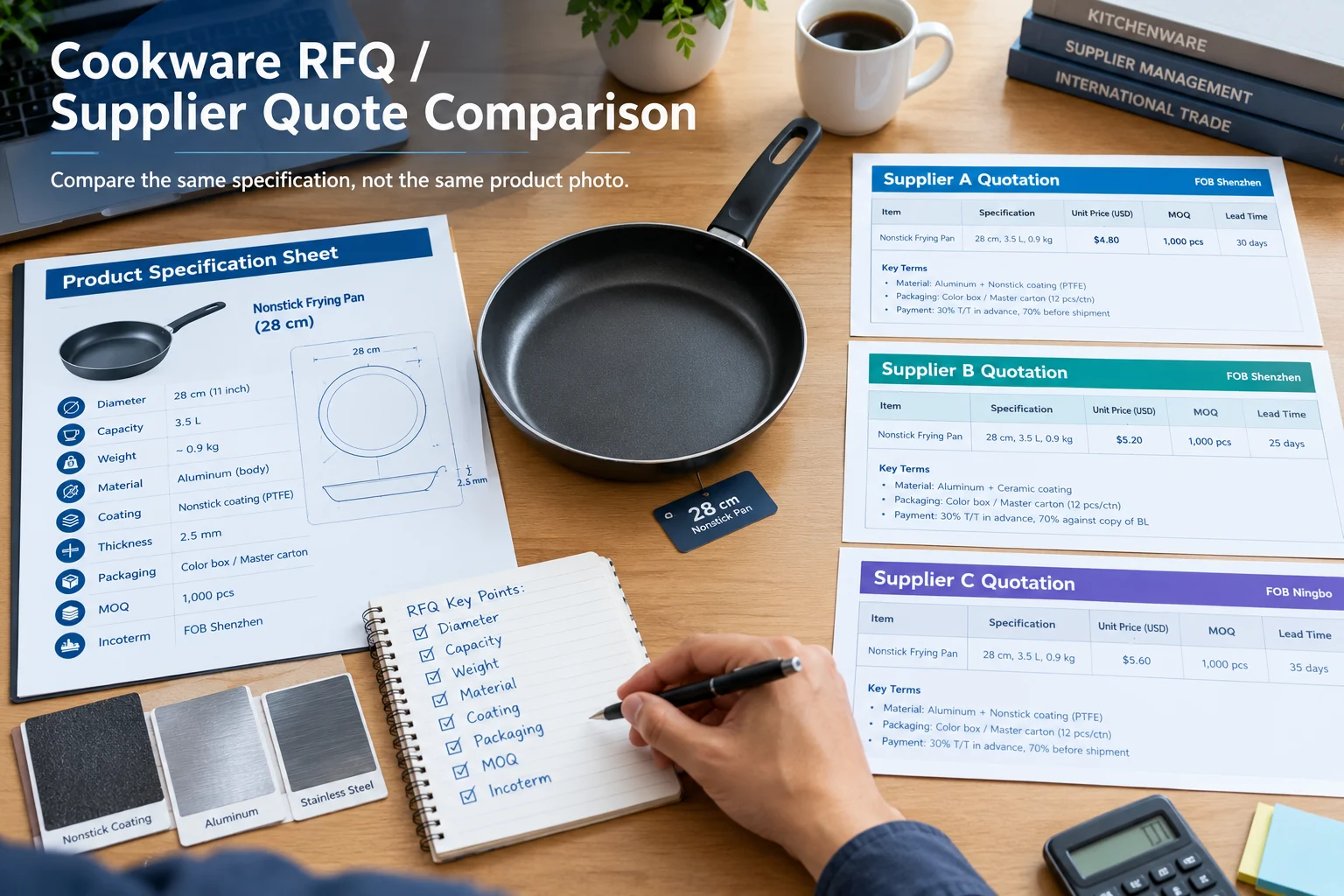
The key is simple: compare the same specification, not the same product photo. A 28 cm nonstick pan can vary by alloy, wall thickness, coating system, induction base, handle attachment, lid, carton, and inspection standard.
Approve the specification and the sample before you compare supplier prices.
Key Takeaways
- Define material, dimensions, coating, handle, packaging, destination market, and Incoterm before requesting prices.
- Use supplier listings and trade fairs to build a shortlist, then verify the legal entity, capability, sample, and payment details.
- Compare landed cost, not only the factory unit price. Approve a production-representative sample and write measurable QC criteria.
- Food-contact evidence must match the final SKU, material, intended use, test method, and destination market.
What cookware can you source from China?
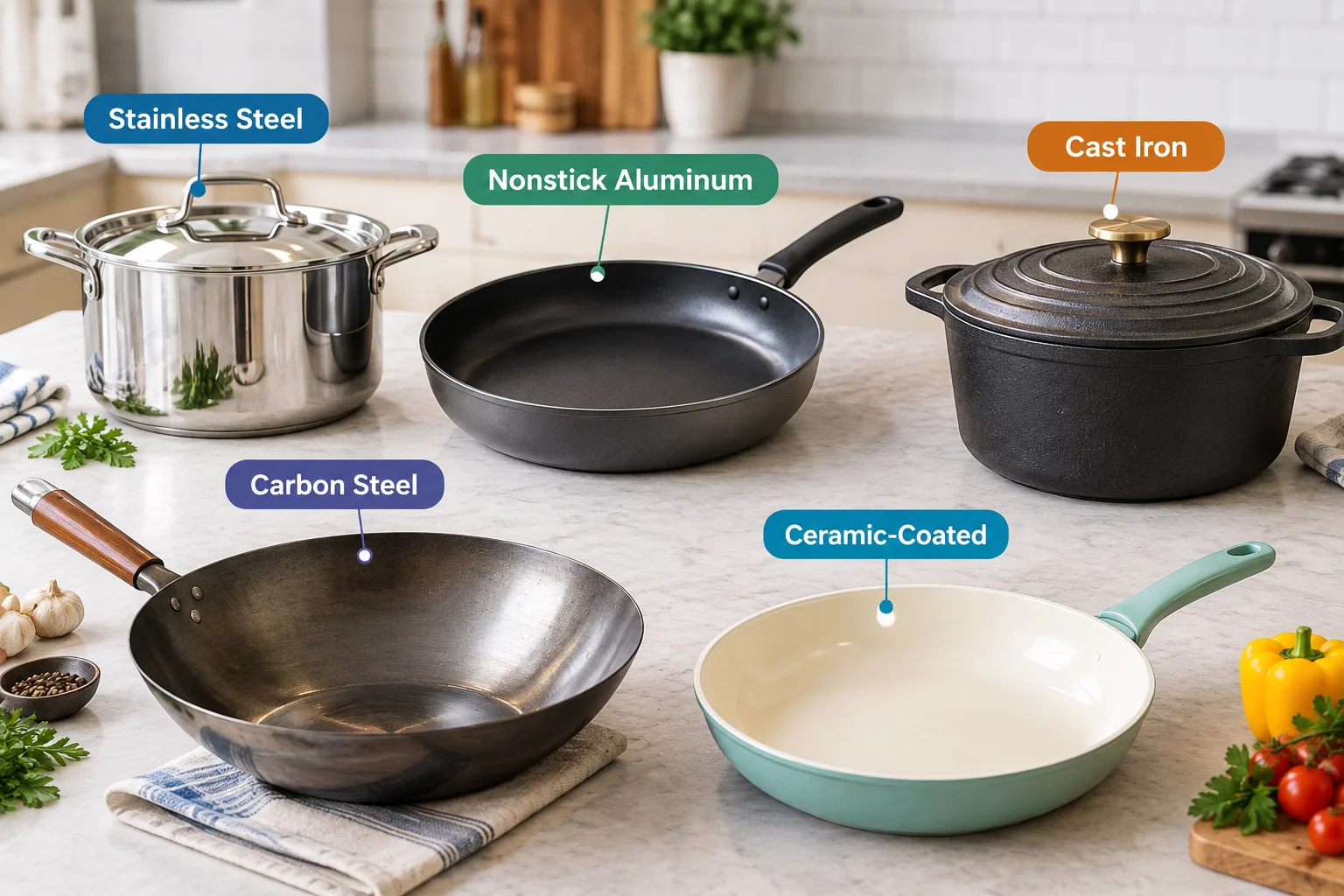
China supplies many cookware constructions, but each one needs a different specification and test plan. The European Commission’s food-contact materials guidance covers materials that contact food, while the exact evidence depends on the material and intended use (European Commission). Start by selecting a construction, not by asking for “a cookware set.”
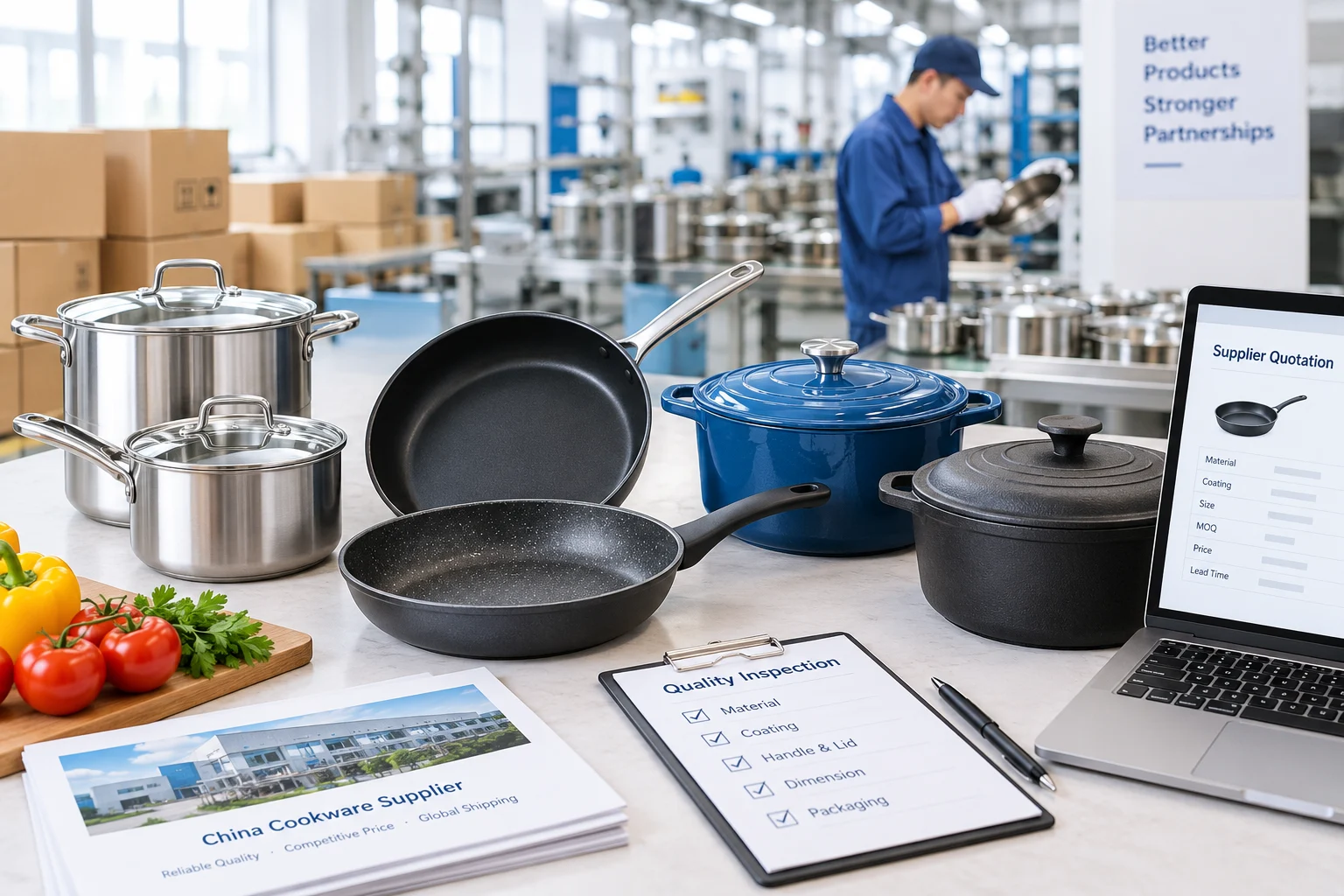
Common options include stainless steel, aluminum with a nonstick coating, cast iron, carbon steel, ceramic-coated aluminum, and induction-compatible pans with a bonded or attached base. You can also specify saucepans, frying pans, stockpots, woks, Dutch ovens, lids, utensils, and coordinated sets.
| Construction | Define in the RFQ | Inspect closely |
|---|---|---|
| Stainless steel | Grade, ply, thickness, finish, handle and lid | Flatness, welds, sharp edges, discoloration |
| Aluminum/nonstick | Alloy, coating system, layers, thickness, base | Coating coverage, scratches, adhesion, warping |
| Cast iron | Weight, enamel or seasoning, handle, lid | Cracks, chips, casting marks, lid fit |
| Carbon steel | Gauge, finish, seasoning, handle attachment | Rust, flatness, burrs, coating consistency |
| Ceramic-coated | Substrate, coating, color, heat-source use | Pinholes, color variation, adhesion, scratches |
Unique insight: “Food grade” is not a complete cookware specification. Your buyer file should name the material, intended food contact, temperature or use conditions, destination market, and evidence required for that SKU. That prevents a generic certificate from being used to support a different product.
How do you find and shortlist cookware suppliers in China?
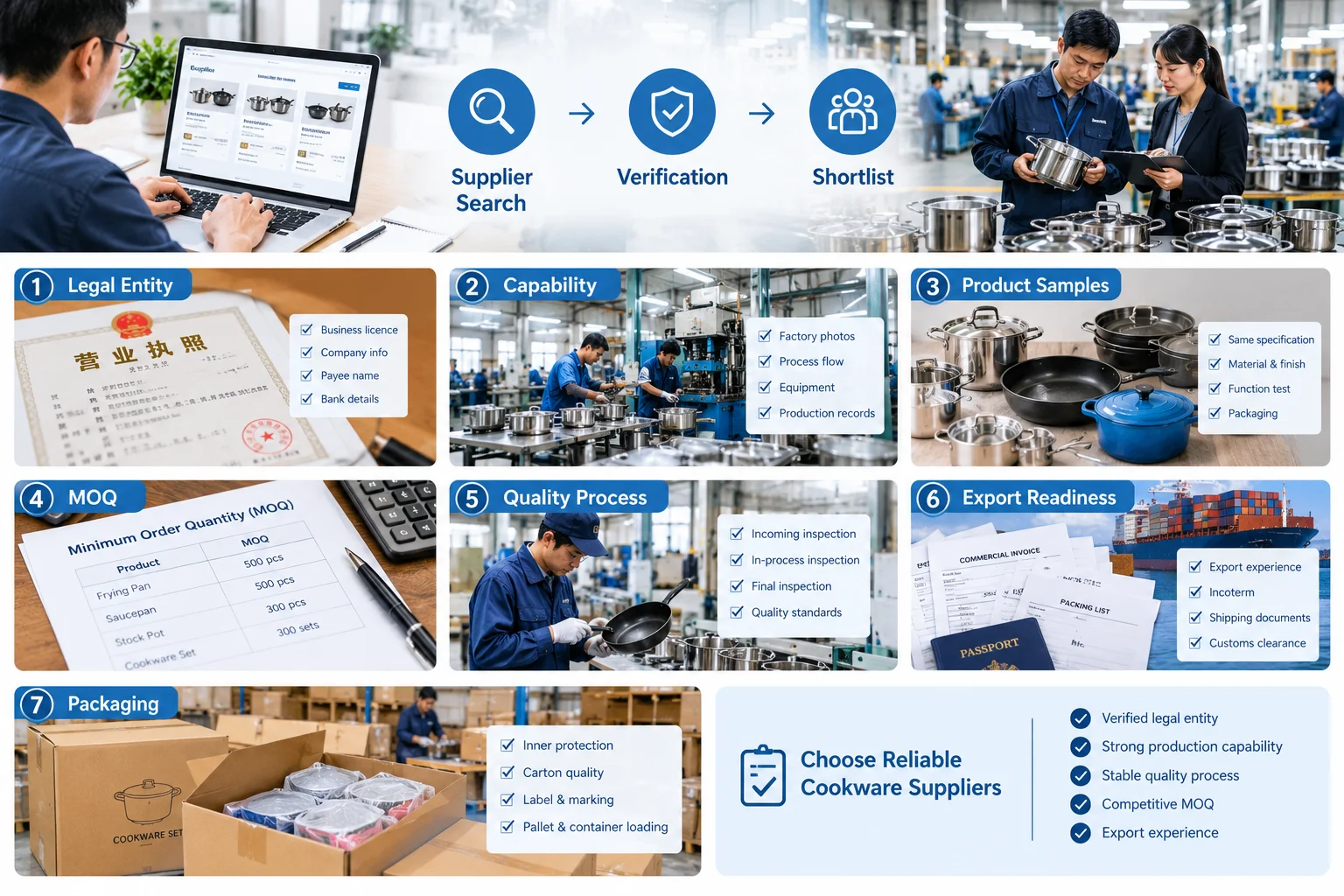
Use marketplaces, Canton Fair meetings, factory referrals, and a China product sourcing service to find leads. Greentime’s published company profile states that it has 29+ years of experience and a network of 10,000+ verified factories; confirm the current wording and what “verified” means before using those figures in a sales claim.
Do not treat a badge, a factory video, or a product catalogue as final proof. Record each supplier’s legal entity, supplier type, product category, factory or workshop address, export markets, MOQ, sample policy, equipment, lead time, payment recipient, and response quality. Then ask the same questions of every shortlisted supplier.
| Screening area | Evidence to request | Stop signal |
|---|---|---|
| Legal entity | Business licence details matching the quotation and payee | Names or bank details do not match |
| Capability | Relevant cookware photos, process description, equipment and records | Only generic catalogue images |
| Commercial fit | MOQ, quantity breaks, lead time, sample cost and payment terms | Terms change without explanation |
| Quality process | Incoming, in-process and final inspection steps | No measurable acceptance criteria |
| Export readiness | Carton data, Incoterm experience and shipping documents | Cannot explain the shipment process |
For a first order, verify the supplier before paying a production deposit. Our guide on how to verify 1688 suppliers provides a document, payment, and order-control checklist that can sit beside this shortlist. A sourcing agent can help with local communication, samples, supplier checks, QC coordination, and consolidation, but you should still approve the exact product and commercial terms.
What should you put in a cookware RFQ?
A complete RFQ is the foundation of a fair price comparison. The ICC’s Incoterms guidance makes clear that shipping obligations and costs depend on the agreed rule, so your request should name the destination and Incoterm instead of asking for a vague “best price” (ICC Incoterms rules).
Attach a drawing or marked-up photo. State the diameter, capacity, height, weight, tolerances, material or alloy, wall and base thickness, coating system, color, handle method, lid, logo, heat-source compatibility, packaging, carton quantity, order quantity, target market, sample requirements, and requested Incoterm.
- Quote quantity breaks such as 500, 1,000, and 3,000 units.
- Separate tooling, artwork, sample, testing, and packaging charges.
- State whether the price includes a lid, accessories, barcode, insert, and master carton.
- Ask for lead time from approved sample and deposit, not from the first message.
- Request the quote validity period and payment schedule.
When every supplier receives the same file, price differences become useful. You can then ask why one supplier uses a thicker base, a different coating, stronger packaging, or a higher inspection allowance. Without that detail, the lowest number may simply describe a different product.
How can you compare China cookware prices fairly?
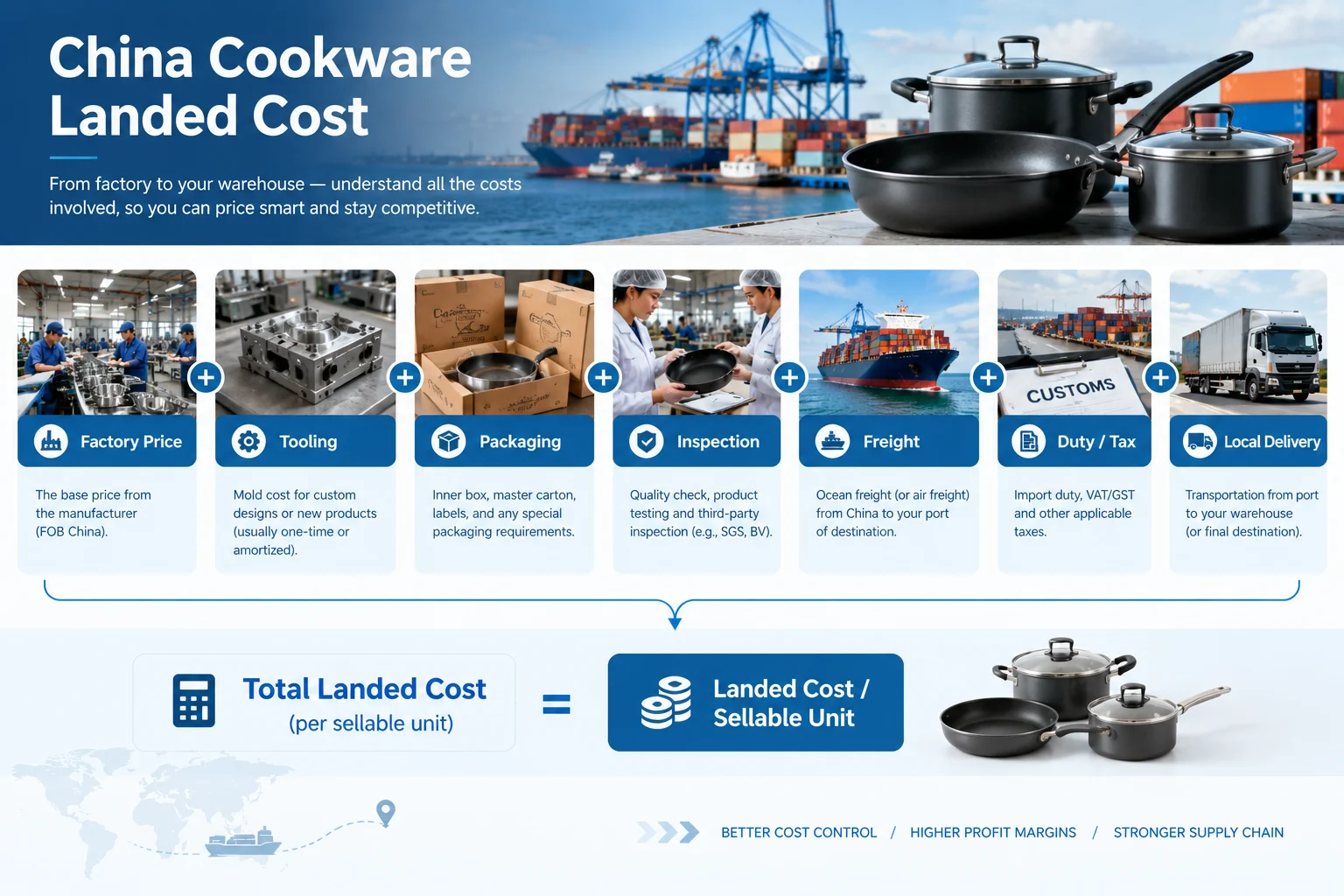
Compare landed cost under the same assumptions, not the lowest listing price. A practical model is: (product + tooling + packaging + inspection + freight + duty/tax + local delivery) ÷ sellable units. The ICC rules determine which party handles key transport and risk tasks, so the same product can show different costs under EXW, FOB, CIF, DAP, or DDP.
| Quote field | Why it matters |
|---|---|
| Exact SKU and material | Prevents a thinner or differently coated product being compared |
| Unit price and quantity break | Shows the effect of MOQ and production volume |
| Tooling and sample fees | Separates one-time development cost from repeat-order cost |
| Packaging and carton data | Changes damage risk, freight volume, and sellable units |
| Inspection and testing | Shows whether evidence and QC are included or extra |
| Incoterm and destination | Defines which freight, risk, duty, and delivery costs remain |
| Lead time and payment | Helps you plan cash flow and launch dates |
Original data opportunity: If you have approved internal RFQs, publish a small benchmark by material, diameter, order quantity, packaging level, and Incoterm. Include the sample size, date, and inclusions. Do not call it an average China cookware price unless the method supports that claim.
For shipping assumptions, see the site’s Incoterms 2020 responsibilities guide. If you need help combining cartons from several suppliers, review the site’s logistics and warehouse services before you finalise the margin.
Which quality and compliance checks matter for cookware?
Food-contact evidence must match the final SKU, materials, intended use, destination market, and test method. The US FDA explains its food-contact-substance framework on its official site, while Regulation (EC) No 1935/2004 provides a general EU framework; neither source turns every imported pan into a universal “approved” product (FDA; EUR-Lex).
Ask the supplier to identify the exact material and coating system. Request the relevant declaration, test report, or laboratory evidence for the market you will sell into. A document for one plastic component, coating, or product size may not support another SKU. Have a qualified compliance reviewer confirm the final file before commercial import.
- Measure diameter, height, weight, wall thickness, and base thickness.
- Check flatness and contact with a level surface, especially for induction products.
- Inspect coating coverage, color, pinholes, scratches, bubbles, and visible edges.
- Test handle attachment, rivets, welds, lid fit, knobs, and sharp edges.
- Confirm heat-source markings, labels, accessories, and packaging match the approved sample.
A supplier statement is useful screening evidence. It is not the same as a final laboratory report or a pre-shipment inspection. Keep the product drawing, approved sample photos, report number, test method, laboratory, and report date in the same order file.
For hands-on checks, link the order to a China quality inspection service. The inspector should work from your acceptance criteria, not from a generic checklist.
How do you approve a cookware sample before bulk production?
Approve the sample against written, measurable criteria and keep the approved reference. A sample only controls production when your purchase order identifies its dimensions, material, coating, finish, packaging, and permitted tolerances.
Use this sequence: send the brief, receive the supplier sample, measure and use-test it, record changes, review a revised sample, sign approval, and retain a golden sample. Check balance, handle comfort, lid fit, coating appearance, base flatness, logo, color, carton, and included accessories.
Sample approval record
- SKU, revision, supplier, date, and reviewer
- Measurements and tolerances
- Photos of product, coating, base, handle, lid, and packaging
- Pass/fail result and corrective actions
- Signature or written approval reference
Personal experience marker: In a real sourcing file, a failed sample should stay visible. If a handle is loose or a base is warped, record the failure and the corrective specification. Hiding the first sample removes the evidence that production improved.
What should pre-shipment cookware QC cover?
Pre-shipment QC should check product, function, appearance, quantity, and packaging before the order is released. Use an agreed sampling plan, including AQL where appropriate, but keep product-specific acceptance criteria for coating, flatness, handles, lids, and packaging.
| Checkpoint | Method | Record |
|---|---|---|
| Dimensions and weight | Measure samples against approved drawing | Values, tolerance, photos |
| Base and flatness | Level-surface check and visual inspection | Pass/fail and sample ID |
| Coating and finish | Visual review and agreed test method | Defect count and location |
| Handles and lids | Fit, attachment, movement, and sharp-edge check | Test result and video/photo |
| Packaging | Carton, separators, labels, and drop-risk review | Carton marks and damage notes |
| Quantity and assortment | Count cartons and verify SKU mix | Packing list and images |
Common failures include warped bases, loose handles, mismatched lids, coating scratches, sharp rims, crushed cartons, missing accessories, wrong labels, and mixed SKU cartons. An inspection cannot fix every design problem, so use in-process checks for coating and assembly risks as well as a final random inspection.
Keep the inspection report with the approved sample and purchase order. If a defect appears, record the corrective action, reinspection result, and decision to release, rework, or hold the shipment.
How do packaging, shipping, and reorders affect cookware margins?
Packaging and freight affect sellable units as much as the factory price. Nesting, separators, lid protection, anti-scratch film, carton strength, moisture protection, palletisation, and container utilisation all change your landed cost and damage risk.
Plan lead time from material booking, tooling, sample approval, production, inspection, rework, packing, and dispatch. For a reorder, keep a revision-controlled specification, approved supplier and SKU, retained golden sample, and change-notification rule. A lower reorder quote is not useful if the coating, base, handle, or carton has changed.
When several suppliers are involved, shipping from China and consolidation planning should be part of the quote discussion. Ask for carton dimensions and gross weight early. They determine freight space and the practical cost of combining orders.
Frequently Asked Questions
Is cookware from China safe to import?
Safety depends on the exact material, construction, intended use, destination market, and evidence file. The FDA and European Commission publish food-contact frameworks, but neither is a universal certificate for every pan. Confirm the final SKU and test method with a qualified compliance reviewer before import.
What is a realistic MOQ for China cookware suppliers?
There is no single standard MOQ. It changes with material, tooling, colour, packaging, customisation, and production schedule. Ask each supplier for several quantity breaks, such as 500, 1,000, and 3,000 units, and record whether the quote includes tooling, packaging, and sample costs.
Which is cheaper: stainless steel or nonstick cookware?
A broad material comparison is unreliable. Price also reflects alloy, thickness, coating layers, base construction, handle, lid, packaging, quantity, and Incoterm. Compare the same written specification and calculate landed cost per sellable unit instead of relying on a listing headline.
Should I buy directly from a factory or use a sourcing agent?
Direct buying may suit a buyer with Chinese-language capability, local inspection resources, and time to manage samples and shipping. A sourcing agent can help find suppliers, coordinate samples, inspect production, consolidate cartons, and manage communication. Compare the total service cost with the time and risk your team can handle.
What tests should I request for cookware?
Request evidence based on the material, coating, intended use, and destination market. Your file may include a material declaration, food-contact report, coating test, dimensional record, and inspection report. Name the exact SKU, laboratory, method, report date, and market. Do not request a generic certificate bundle.
How do I reduce cookware defects?
Use a detailed specification, a production-representative sample, a retained golden sample, and measurable acceptance criteria. Add in-process checks for coating and assembly, then arrange final inspection for dimensions, flatness, handles, lids, quantity, labels, and packaging before shipment release.
China cookware sourcing guide: what should you do next?
A controlled cookware order follows a clear sequence: define the SKU, shortlist suppliers with evidence, normalise the quotes, approve the sample, inspect production, and compare the landed cost. That process gives you a better basis for price, quality, and reorder decisions than a marketplace listing alone.
Need help sourcing this category? Talk to our team with your product, quantity, destination market, and delivery term. Compliance requirements vary by market and product, so confirm the final evidence before commercial import.

Gong Zheng is a blog editor for Greentime, focusing on global sourcing, wholesale market trends, and practical advice for international buyers. Drawing on extensive experience in digital marketing and cross-border trade, he shares expert insights to help small and medium-sized enterprises source products more efficiently and avoid common pitfalls. Passionate about connecting buyers with reliable suppliers, he writes in a clear, approachable style that makes complex topics easy to understand.