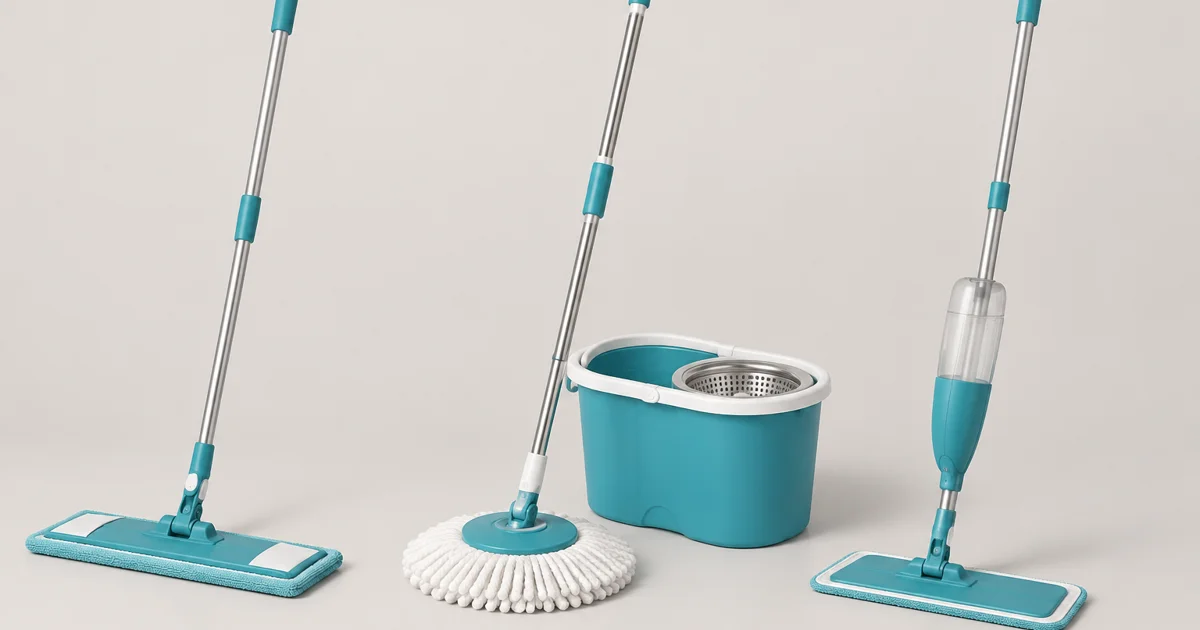
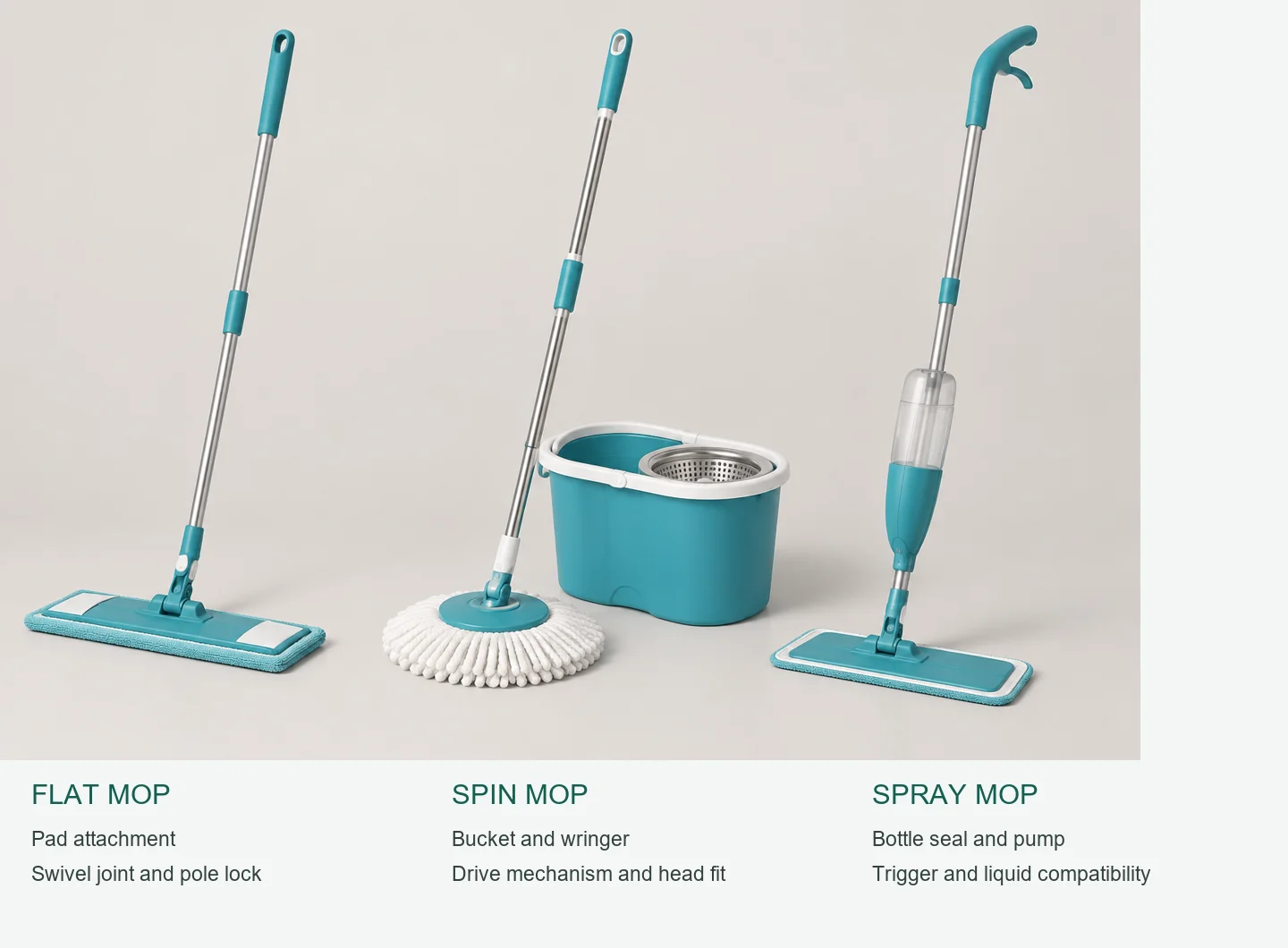
For importers buying mops wholesale from China, the choice starts with the cleaning task and the replacement system. Flat mops suit compact kits and washable pad programs. Spin mops combine a round head with a bucket-based wringing mechanism. Spray mops offer an integrated reservoir for routine spot cleaning. Each design brings different quality risks, packaging requirements and after-sales needs.
This 2027 sourcing guide compares the three systems and explains how to specify, sample, inspect and order them. It is a purchasing framework prepared in November 2026, rather than a forecast of 2027 prices or demand. Start with your target customer and destination market, then compare suppliers against one written specification. Explore the wider Greentime cleaning-items range when planning complementary products.
Which mop system should your wholesale range include?
Choose the system around the job your customer expects it to perform. A flat mop provides broad surface contact and a removable pad. A spin mop provides bucket-assisted wringing. A spray mop carries liquid on the handle assembly. Product construction determines actual cleaning performance, so category names alone cannot establish durability or floor compatibility.
| Buying factor | Flat mop | Spin mop | Spray mop |
|---|---|---|---|
| Typical system | Rectangular plate, swivel joint and detachable pad | Round head, absorbent strands and wringer bucket | Flat head, reservoir, tube, pump and trigger |
| Assortment role | Compact household kits and replacement-pad ranges | Customers seeking a bucket-and-mop set | Convenient spot-cleaning and light maintenance kits |
| Key sample risks | Loose swivel, weak pad attachment, bending pole | Unstable bucket, poor wringing, weak drive mechanism | Leaks, inconsistent spray, failed trigger or seals |
| Replacement parts | Pads, head, pole or attachment clips | Heads, handles and bucket mechanism components | Pads, bottles, seals and pump assemblies |
| Packaging question | Can the handle separate without weakening its joint? | How does the bucket affect carton volume? | How are the bottle and trigger protected in transit? |
Flat mop: specify the pad interface first
A flat mop wholesale order should define plate dimensions, pad construction and attachment geometry together. Hook-and-loop, pocket and clip systems are not automatically interchangeable. Ask for usable pad dimensions, attachment strength, cleaning instructions and a replacement sample. Test the joint under furniture and while turning, where a display sample may behave differently from routine use.
Spin mop: buy the bucket and mechanism as one system
A spin mop depends on compatible head, pole, drive and basket components. Confirm whether wringing uses a foot pedal or a handle-driven mechanism. Check bucket stability, carrying comfort, splash behavior and water release under the supplier’s instructions. A metal basket alone does not establish the strength of its axle, gears, pedal or surrounding plastic.
Spray mop: treat liquid compatibility as a design requirement
A spray mop adds seals, a bottle connection, tubing, a pump and a trigger to the pad-and-pole system. Define which liquid the customer may use. Test bottle removal, inverted storage, spray consistency and repeated operation using an agreed method. Do not promise compatibility with every cleaner, disinfectant or solvent without evidence for the complete fluid path.
What belongs in a mop supplier specification?
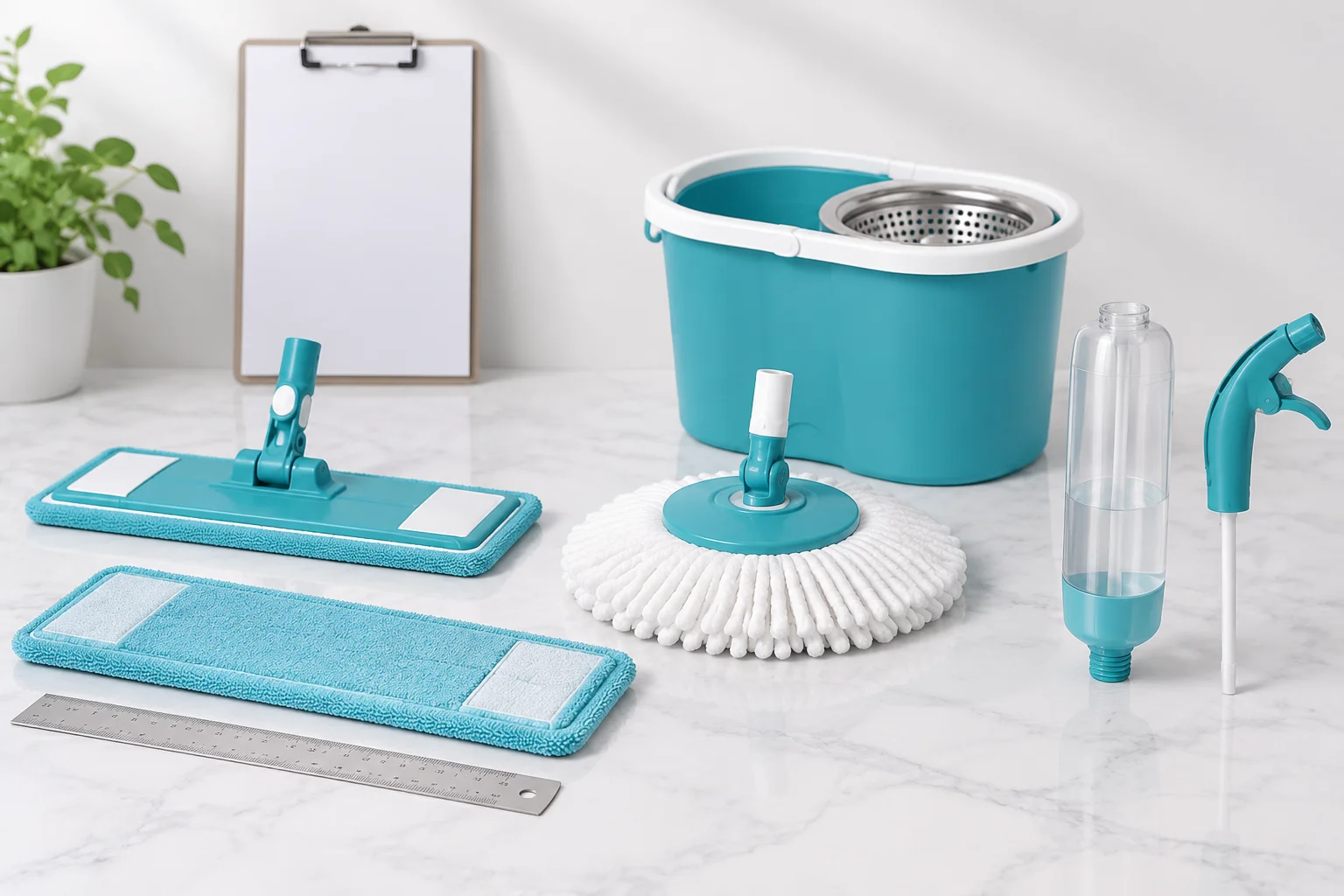
Send suppliers a specification covering the complete sellable kit. Product photographs show appearance, but leave materials, dimensions, tolerances and included accessories open to interpretation. Put the drawing, bill of materials, artwork and acceptance criteria under one revision reference. This makes quotations comparable and gives inspectors a stable basis for checking production.
| Component | What to state in the RFQ | What to confirm on the sample |
|---|---|---|
| Pole and handle | Material, tube dimensions, assembled length, sections, locking system and finish | Grip comfort, joint play, lock retention and visible burrs |
| Head and connection | Head dimensions, swivel range, connection geometry and spare-part reference | Movement under furniture, pull-off resistance and repeated assembly |
| Pad or mop strands | Fiber composition, finished dimensions, construction, mass and care method | Fit, absorbency, lint, attachment and performance after washing |
| Bucket or spray system | Materials, capacity where relevant, mechanism, seals and permitted liquids | Stability, function, leakage and accessible maintenance |
| Retail kit | Contents, spare pads, instructions, barcode and replacement SKU | All parts present, correct artwork and usable assembly instructions |
| Export carton | Units, dimensions, weight, protection and shipping marks | Secure packing, component protection and carton identification |
Terms such as “microfiber,” “stainless steel” and “heavy duty” need more detail. Ask which component the term describes and how the supplier verifies it. Agree pad composition and finished construction rather than relying on a material label. For metal poles, establish the relevant material specification and finish instead of assuming that a polished appearance proves corrosion resistance.
Replacement compatibility deserves its own drawing. Two heads can look identical while using different sockets or attachment positions. Approve a replacement head on the finished pole and retain both samples. For a broader supplier assessment, use the cleaning-tools supplier checklist alongside the product specification.
How do you compare Chinese mop suppliers and quotations?
Compare suppliers against the same product revision, quantity and delivery basis. Establish whether you are speaking with the manufacturer, a trading company or a sourcing partner. Ask which facility performs assembly and who controls critical purchased components. The quotation should identify the legal seller, production responsibilities and how changes will be approved.
Request MOQ separately for the product model, color, pad fabric, printed box and custom tooling. A stock-color order and a private-label program can have different minimums. Ask for a schedule covering sample approval, artwork confirmation, material preparation, production, inspection and dispatch. Treat supplier lead times as quotation-specific commitments rather than industry guarantees.
Buyer decision rule: Compare the cost of a usable kit and its replacement program. A lower-priced mop with an incompatible refill can create a separate stock problem after the first shipment.
Ask each supplier to separate the unit price, sample charges, tooling, printing setup, testing and optional spare parts. Confirm ownership and access arrangements for custom molds before paying tooling charges. Keep the approved sample, component list and packaging artwork attached to the commercial agreement. A supplier’s catalog should not substitute for these records.
Which sample and production checks matter most?
Test the failures that would make the mop difficult to use, returnable or unsafe. Agree the method and acceptance limit before production, including the floor surface, test liquid, load and operating sequence. Generic cycle counts cannot establish suitability across every design. Keep a signed reference sample and record deviations during the pilot run.
| System | Suggested inspection focus | Record in the agreement |
|---|---|---|
| Every mop | Assembly, sharp edges, pole lock, joint movement, pad fit and complete kit contents | Methods, fixture or load, acceptable movement and defect definitions |
| Flat mop | Pad attachment, swivel durability, head deformation and wash-related pad changes | Surface, wash method, conditioning and dimensional limits |
| Spin mop | Bucket carrying, wringer operation, splash control and mechanism durability | Water fill, operating method, load and agreed function criteria |
| Spray mop | Bottle seal, trigger operation, spray consistency and storage leakage | Liquid, orientation, time, actuation method and leak criteria |
| Packed product | Missing parts, protected poles, trigger clearance and carton condition | Pack-out checklist and a transport test appropriate to the route |
Separate sample approval from production acceptance. A handmade sample may use different parts or assembly conditions from a full order. Review pilot units and inspect finished goods against the approved revision. If using a sampling plan, agree the inspection level, defect classes, acceptance rules and lot definition. Sampling supports a shipment decision; it cannot guarantee every unit.
Floor compatibility also requires care. Check the floor manufacturer’s instructions and evaluate the pad, liquid and moisture level together. A mop described as suitable for wood still needs evidence matching the intended floor finish and use. Cleaning tools should not carry antimicrobial or disinfecting claims solely because they remove visible dirt.
How should importers calculate landed cost and packing?
Calculate landed cost using the actual packed product and the named delivery term. Include product cost, relevant origin charges, freight, insurance, destination handling, duty and other applicable costs. Avoid counting charges already included in the quotation twice. Divide the total by the quantity you expect to receive in sellable condition.
Bucket sets can consume space that is not obvious from a unit-price comparison. Ask for a packed sample and measured master-carton dimensions. Check whether nesting affects finish or creates assembly work. For flat and spray mops, a sectional pole may reduce length, but its connection still needs evaluation. Request freight quotations using the confirmed carton data.
The ICC’s Incoterms® 2020 rules allocate costs, risks and obligations between buyer and seller. State the selected rule, named place or port and version in the quotation. Confirm the appropriate rule with your freight partner. Separately document payment, product acceptance, remedies and any other terms the trade rule does not settle.
What should a 2027 private-label order include?
A private-label mop program needs accurate artwork, traceable product references and a workable refill plan. Confirm the destination market before finalizing labels and instructions. Establish who checks product requirements and who supplies supporting documents. Review requirements again before the 2027 shipment, because this guide is prepared ahead of that ordering year.
Start customization with the parts customers handle: grip, locking mechanism, pad fit and bottle removal. Color and logo changes should follow a functional sample review. Define logo position, print method, color reference, barcode, kit contents and assembly illustrations. Request a packed pre-production sample so artwork and product configuration can be approved together.
For U.S. shipments, U.S. Customs and Border Protection’s importer guidance is a starting point for understanding import responsibilities. Confirm classification, origin marking, documentation and applicable duties for the actual product with a qualified customs professional. A manual mop, an electrically powered model and a kit containing cleaning liquid can require different reviews.
Do not accept a generic “CE,” “FDA” or factory-audit claim as proof that every mop in a catalog meets your market’s requirements. Ask what requirement applies, which SKU was assessed and which legal entity appears on the document. Verify recycled-content and environmental claims at component level. Avoid promising whole-product recyclability based only on one material.
Copy this wholesale mop RFQ checklist
A useful RFQ lets suppliers quote the same product and makes unanswered questions visible. Include enough information to define the kit without imposing unsupported performance claims. Ask suppliers to list deviations explicitly. Resolve those deviations before approving samples, rather than assuming the quoted item matches the reference photograph.
- Product: flat, spin or spray mop; reference image; intended surface and customer.
- Construction: pole, joint, head, pad, bucket or spray-system specifications.
- Quantity: units per model and color; requested spare pads and replacement parts.
- Branding: stock or custom color, logo, barcode, artwork and instruction languages.
- Quality: approved sample, inspection methods, acceptance criteria and required evidence.
- Packing: kit contents, retail pack, carton quantity, dimensions and gross weight.
- Commercial terms: destination, delivery basis, schedule, sample fees, tooling, payment and quote validity.
Ask suppliers to confirm which replacement items will remain available and how changes will be communicated. Agree a common part reference for the kit and its refills. If a factory changes the socket or pad attachment, require approval before shipment. This small control can prevent a later order of refills from becoming incompatible with earlier stock.
Frequently asked questions
What is the MOQ for wholesale mops from China?
There is no universal MOQ across suppliers or mop designs. Request minimum quantities for the model, color, logo, printed packaging and custom components separately. Compare stock specifications with private-label options. Confirm whether a mixed-model order changes the MOQ and whether the quoted price assumes a particular carton or shipment quantity.
Which is better for a first order: flat, spin or spray mop?
Choose according to the customer and the support you can provide. Flat mops offer a simple pad-based system. Spin mops add a bucket and wringing mechanism. Spray mops add liquid-handling components. Evaluate all three against your target price, shipping constraints and replacement program, then trial the best-fitting specification.
Can replacement pads from different factories be mixed?
Only after confirming fit and function on the actual mop. Pad dimensions, pocket shape, hook-and-loop coverage and clip positions can differ. Approve a cross-supplier sample and record the interface drawing. Keep replacement SKUs tied to the relevant product revision so a later design change does not create misleading compatibility claims.
Should a spray mop be shipped filled with cleaning liquid?
Confirm the commercial need and product requirements before including liquid. A filled kit introduces formulation, labeling, leakage, transport and destination-market questions beyond the manual mop itself. Ask the supplier and freight partner to assess the actual formulation and shipment. Do not assume that a quotation for an empty reservoir includes these requirements.
How long does a private-label mop order take?
Timing depends on the approved design, component availability, tooling, artwork, quantity and production schedule. Request dates for each approval and production milestone. Confirm when the lead-time clock begins and which events can change it. Add inspection, corrective work and transport to your purchasing plan instead of using production time alone.
Plan your mop sourcing request with Greentime
For a 2027 mop wholesale program, begin with a focused product brief and a realistic trial order. Greentime’s product sourcing service provides a place to discuss the models, specifications and supplier coordination your order needs. Send your reference products, quantities, destination market, branding requirements and target shipment window to start the discussion.
Before increasing volume, confirm the complete kit, replacement compatibility, packed dimensions and agreed inspection methods. These decisions give a flat mop, spin mop or spray mop order a clear acceptance basis. They also make repeat purchasing easier when you need the next shipment to match the first.

Gong Zheng is a blog editor for Greentime, focusing on global sourcing, wholesale market trends, and practical advice for international buyers. Drawing on extensive experience in digital marketing and cross-border trade, he shares expert insights to help small and medium-sized enterprises source products more efficiently and avoid common pitfalls. Passionate about connecting buyers with reliable suppliers, he writes in a clear, approachable style that makes complex topics easy to understand.