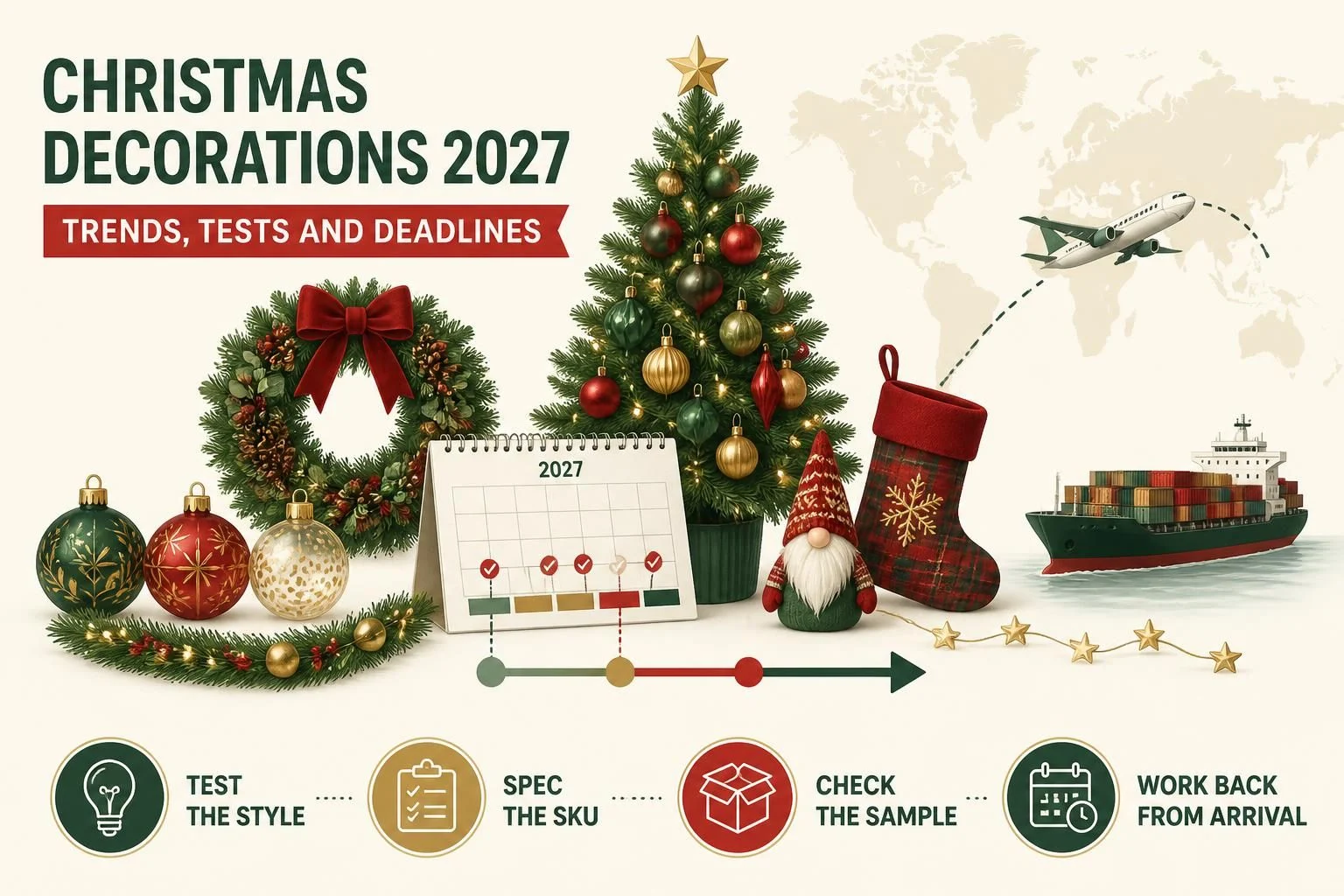
To plan a 2027 Christmas decoration order, validate each style against buyer evidence, approve the exact product for its destination market, and work backward from the date stock must reach your warehouse. A supplier catalog can help you find ideas. It cannot confirm what your customers will buy or set a reliable deadline for your order.
Key Takeaways
- Treat possible 2027 styles as hypotheses until sales history, retailer requests, or customer feedback support them.
- Define and review each SKU, its packaging, intended use, and destination-market requirements before bulk production.
- Set order milestones from your required warehouse date, then confirm each stage with the supplier and freight provider.
- There is no universal Christmas order cutoff or lead time that applies to every product, factory, route, and destination.
What Christmas decoration styles should buyers test for 2027?
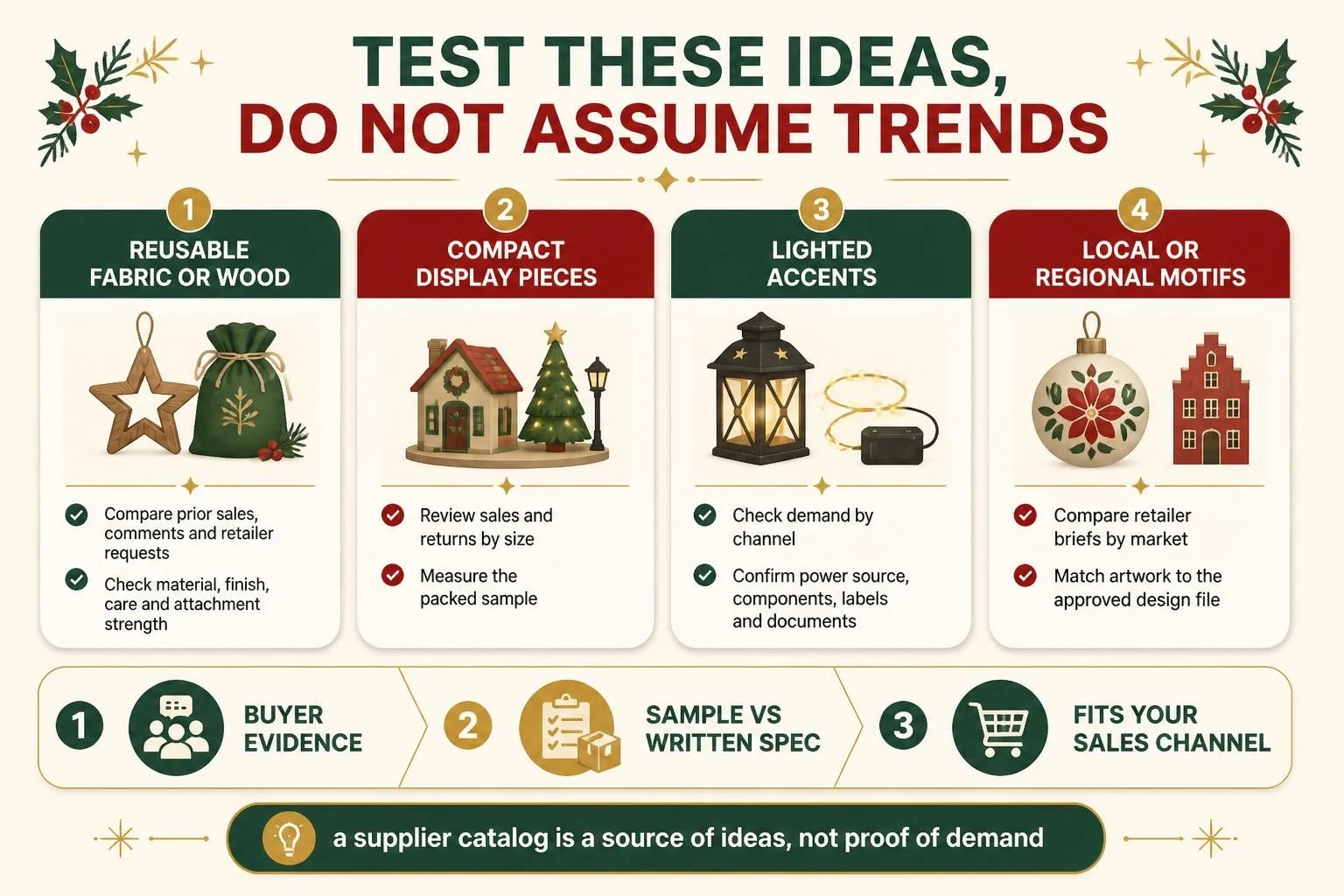
There is no verified, universal forecast for Christmas decoration styles in 2027. Build a shortlist from your own sales records and buyer feedback, then use samples to decide which ideas deserve an order. Treat a new supplier catalog as a source of product ideas, not proof of market demand.
You might choose to test reusable fabric or wood pieces, compact displays for smaller homes, lighted accents, or motifs adapted to a local market. These are examples for consideration, not confirmed trends. Your customer, retail channel, price point, and destination market determine whether any one of them belongs in your range.
Use the same three checks for every candidate: look for buyer evidence, compare a sample with the written specification, and check whether the packed product fits your sales channel.
- Reusable fabric or wood: Compare prior sales, customer comments, and retailer requests. Check the material, finish, care information, and attachment strength on the sample.
- Compact display pieces: Review sales and returns by size, then measure the packed sample. Confirm it fits your shelf, parcel, and carton plan.
- Lighted accents: Check demand by channel. Ask which power source, components, labels, and product documents apply to the exact SKU and destination.
- Local or regional motifs: Compare retailer briefs and customer feedback by market. Match the sample artwork to the approved design file.
Product categories to consider for your 2027 shortlist
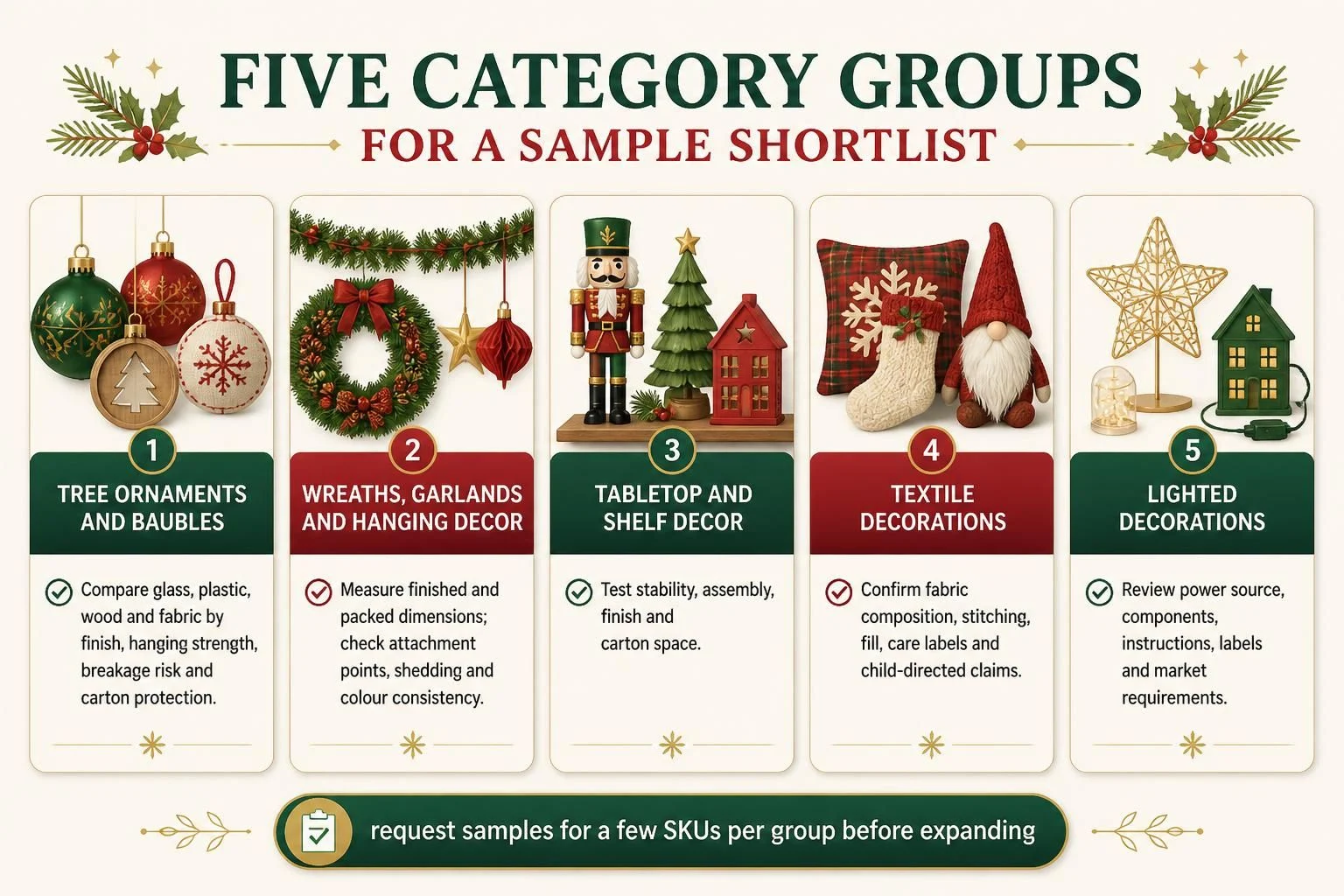
Start with categories your buyers already stock or have requested. The following are practical groups for a sample shortlist, not a forecast of 2027 sales:
- Tree ornaments and baubles: Compare glass, plastic, wood, and fabric options by finish, hanging strength, breakage risk, and carton protection. Check the size and pack count against your shelf or online listing plan.
- Wreaths, garlands, and hanging decor: Measure the finished and packed dimensions. Review attachment points, shedding, color consistency, and whether the item can be displayed or stored as your channel requires.
- Tabletop and shelf decorations: Test compact figurines, small trees, and display sets for stability, assembly, finish, and the amount of space each SKU takes in a carton or on a shelf.
- Textile decorations: Consider stockings, fabric ornaments, and soft decorative figures. Confirm fabric composition, stitching, fill, care labels, and any child-directed claims before approving the sample.
- Lighted decorations: Review the exact power source, components, instructions, labels, and destination-market requirements. Seek specialist advice on applicable electrical and battery rules before committing to a design.
Select only the categories that fit your price point, sales channel, and destination market. Request samples for a small number of SKUs in each selected group, then compare buyer response, landed cost, packaging, and product-specific checks before expanding the range.
The 2026 wholesale Christmas decoration list can help you identify items to review. It is a prior-year product list, not evidence that those items will sell in 2027. Compare its ideas with your own sales by SKU, channel, and destination before you decide what to sample.
Keep notes on why each candidate stays or leaves the range. Record the demand signal, quoted price, sample result, packed dimensions, and next action. If you cannot name a buyer or evidence source for a style, keep it in the idea list rather than treating it as a confirmed trend.
What should you define before requesting samples?
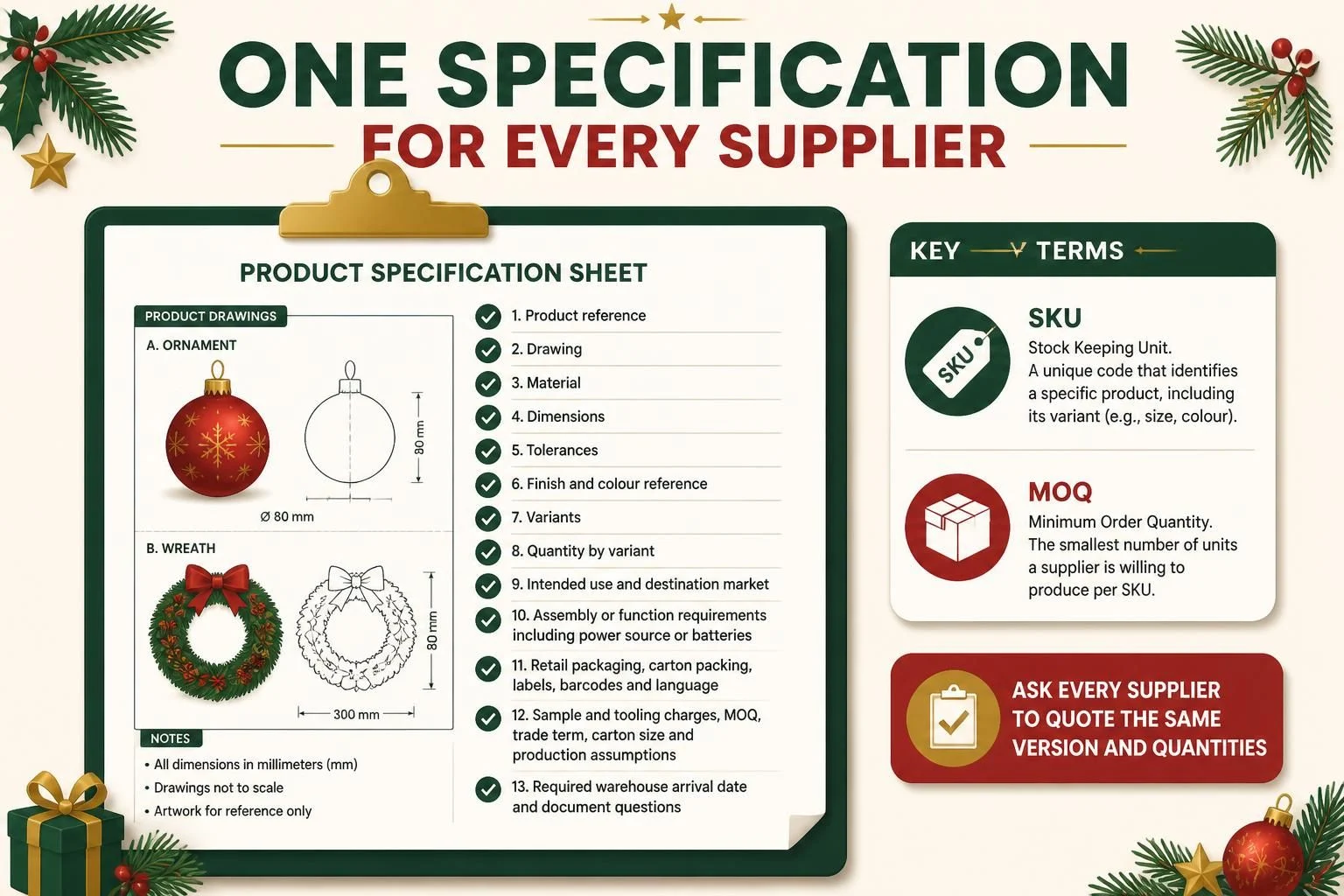
Send suppliers one clear specification for each product so their quotes and samples can be compared. Start with a reference image or drawing, then state what the product is made of, how it should look and function, where it will be sold, and when you need it delivered.
Include these details in your request for quotation:
- Product reference, drawing, material, dimensions, tolerances, finish, and color reference
- Variants, order quantity by variant, intended use, and destination market
- Assembly or function requirements, including power source or batteries where relevant
- Retail packaging, carton packing, labels, barcodes, and any required language
- Sample and tooling charges, MOQ, quoted trade term, carton size, and the supplier’s stated production assumptions
- Required warehouse arrival date and the inspection or product-document questions you need answered
A SKU (stock keeping unit) is one specific product version, such as a size or color. An MOQ (minimum order quantity) is the smallest quantity a supplier will accept for an order or variant. Ask suppliers to state both the SKU-level quantities and any MOQ that applies.
Ask every supplier to quote the same version and quantities. If one quote leaves out packaging, tooling, or carton data, ask for the missing information before comparing prices. A lower unit price may not represent the same product or delivery plan if the specifications differ.
You can browse the Christmas decorations category for product references. Confirm the exact material, size, finish, packaging, and market for the item you want. A category page or photograph does not replace a written SKU specification.
Which sample and quality checks fit each product type?
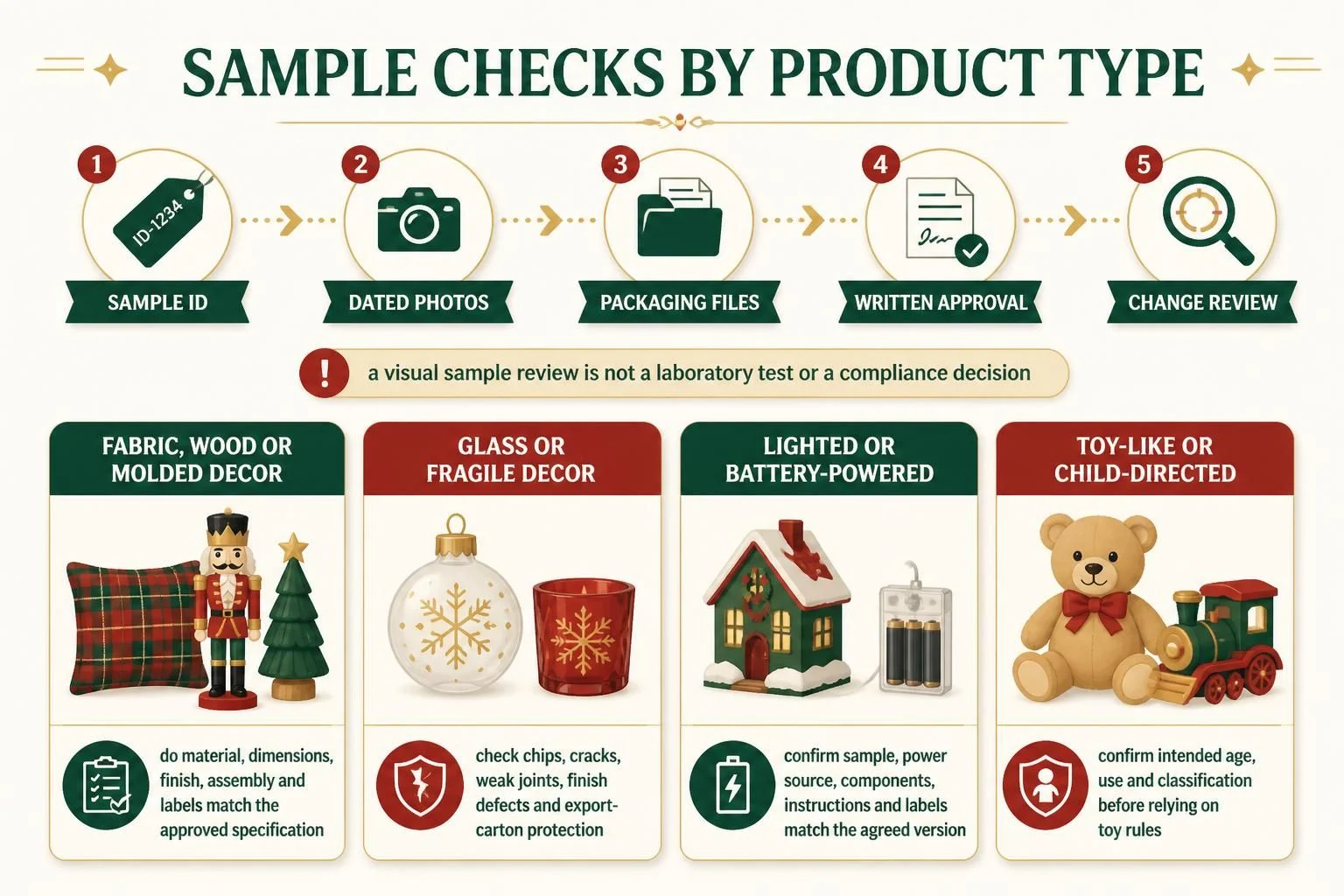
Approve the exact sample and written specification you expect the factory to produce. Keep a sample ID, dated photographs, packaging files, and written approval together. If the supplier later changes a material, component, finish, or design, review the affected requirements before production continues.
For a general decoration, compare the sample with the approved reference for material, dimensions, color, finish, assembly, attachment strength, sharp edges or breakage risks where relevant, packaging protection, labels, and carton marks. The checks should reflect the product. A glass ornament, soft fabric figure, and assembled wall decoration do not have identical risks.
Some products need additional review. For a lighted item, identify the electrical and battery questions that apply to its design and destination. For a product marketed to children or classified as a toy, confirm the classification and applicable toy-safety requirements before placing the order. Candles, open-flame products, small parts, and breakable items also call for product-specific risk review.
For products classified as toys in the EU, check the applicable toy-safety rules before ordering. Regulation (EU) 2025/2509 says that the Regulation applies from August 1, 2030, while Articles 28-44 and 49-55 apply from January 1, 2026. It also repeals Directive 2009/48/EC with effect from August 1, 2030. These rules concern toys; they do not classify every Christmas decoration as a toy. Confirm the current rules and classification for your product and sales date.
A visual sample review is not a laboratory test or a legal compliance decision. Ask a qualified laboratory or compliance adviser to confirm the classification, test plan, and documents for a specific SKU when the answer is unclear. For a practical overview of inspection steps, see Greentime’s guide to product quality inspection in China. The guide is general information; confirm the inspection scope and any product-specific tests for your order.
Use these product-specific prompts during sample review:
- Fabric, wood, or molded decor: Do the material, dimensions, finish, assembly, and labels match the approved specification? Seek specialist review when intended use, chemical treatment, coatings, or child-directed claims affect applicable rules.
- Glass or fragile decor: Check for chips, cracks, weak joints, finish defects, and gaps in export-carton protection. Seek help if the product has electrical parts, special use claims, or destination rules that need interpretation.
- Lighted or battery-powered item: Confirm the sample, power source, components, instructions, and labels match the agreed version. Get advice before choosing market-specific electrical, battery, or labeling requirements.
- Toy-like or child-directed item: Confirm intended age, use, and product classification before relying on toy rules, marks, or test reports.
Treat these prompts as questions for product review. They do not replace the applicable law, a lab’s test plan, or an inspection agreement. The Christmas tree ball ordering guide covers a narrower product; apply checks to the actual item and market you plan to serve.
How do you calculate a 2027 order deadline?
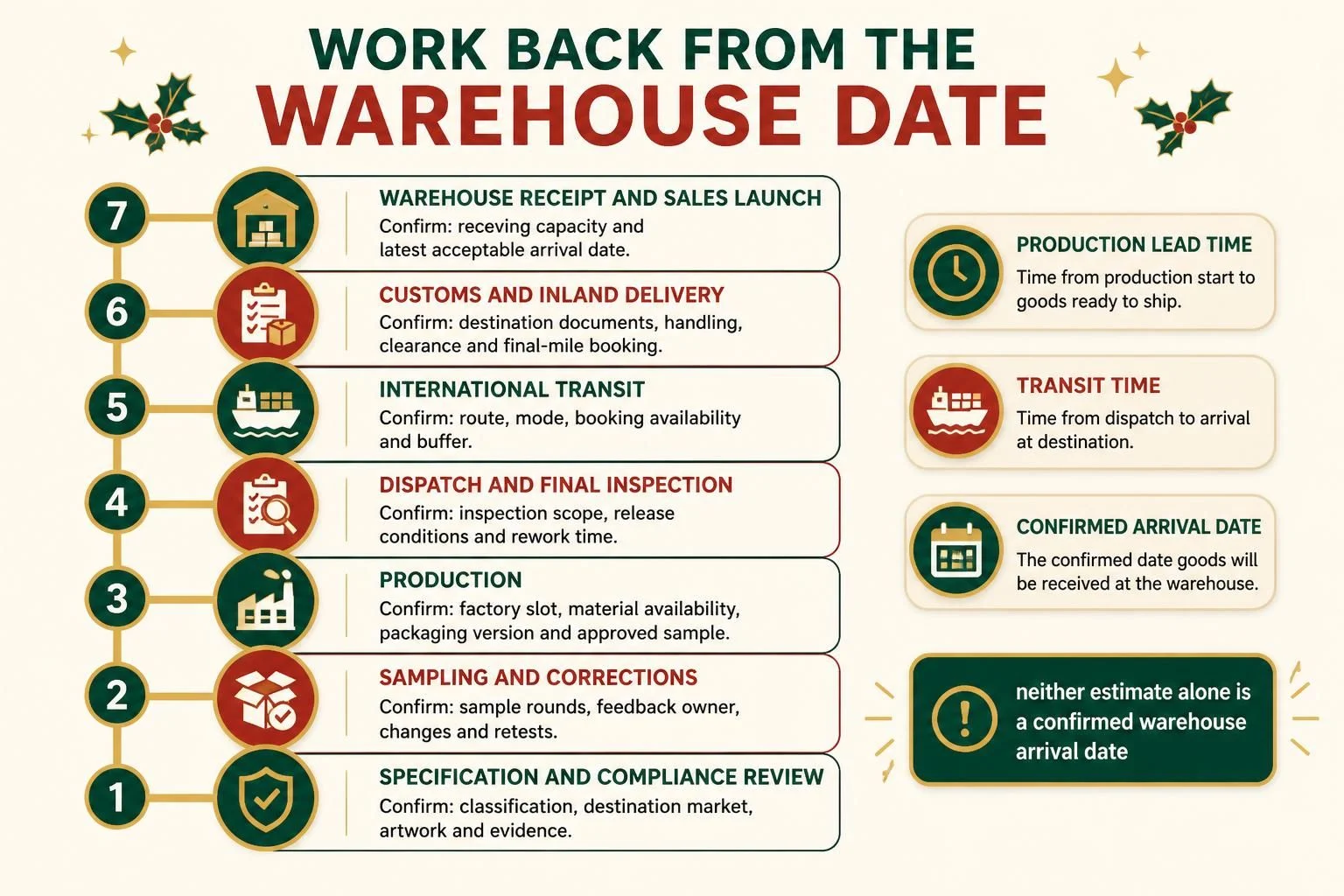
Start with the date your stock must be available at the warehouse, then work backward using confirmed dates for your order. Ask the supplier and freight provider to identify the assumptions behind each milestone. Do not use a generic calendar as a promise of production or transit time.
| Plan backward from | Confirm before fixing the date |
|---|---|
| Warehouse receipt and sales launch | Receiving capacity and the latest acceptable arrival date |
| Customs and inland delivery | Destination documents, handling, clearance, and final-mile booking |
| International transit | Route, transport mode, booking availability, and any agreed buffer |
| Dispatch and final inspection | Inspection scope, release conditions, and time allowed for rework |
| Production | Factory slot, material availability, packaging version, and approved sample |
| Sampling and corrections | Sample rounds, feedback owner, changes, and any retest needed |
| Specification and compliance review | Product classification, destination market, artwork, and required evidence |
Keep the terms in this schedule distinct. Production lead time is the supplier’s estimated time to make the approved order. Transit time is the carrier’s estimated time to move it between locations. Neither estimate alone is a confirmed warehouse arrival date; customs, inland delivery, and receiving capacity also affect when stock is available.
Write the confirmed date beside each stage and identify who owns it. Leave space for corrections, rework, booking changes, and receiving delays based on your own order and route. The amount of time needed can change with the SKU, the factory’s current schedule, transport availability, and destination requirements.
For example, if your retail team sets an October 2027 warehouse target, use that date to request a supplier and freight schedule. Do not infer from October a universal order cutoff or assume that a supplier can meet the date. Confirm sample approval and any needed product review first. Get dated estimates for production and inspection. Then confirm dispatch, transit, customs, and inland delivery before you commit.
Changes after sample approval can affect the plan. A new artwork file, packaging change, material substitution, failed sample, or additional review may change which work must be repeated. Put the change process in writing and ask the supplier to update the affected milestones. If you are sourcing through Yiwu, Greentime’s Yiwu logistics and shipping page describes related logistics and warehousing services. Confirm that the listed scope and dates fit your order before relying on them.
What belongs in the supplier approval file?
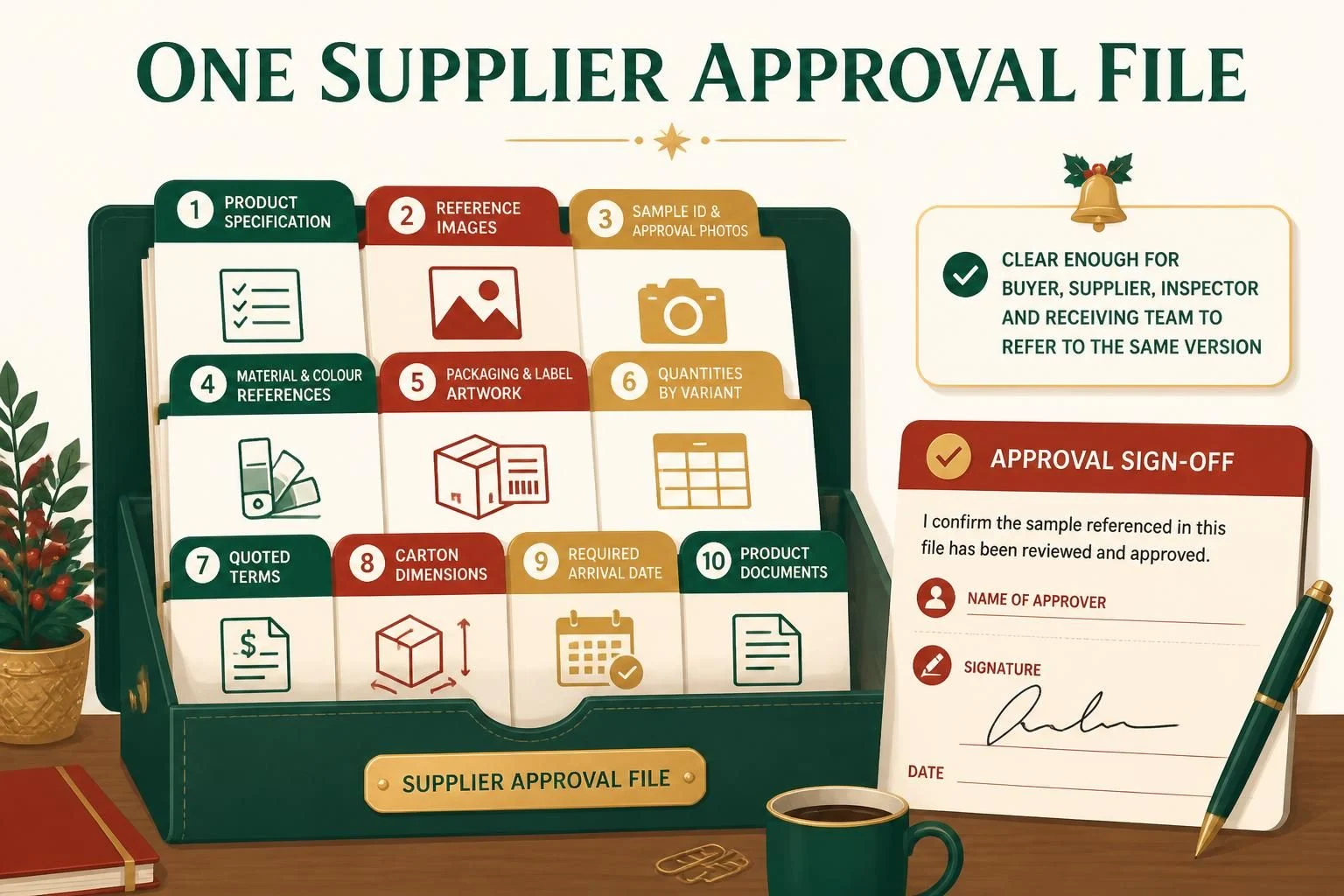
Keep one file that shows exactly what you approved and what the supplier quoted. It should be clear enough for your buyer, supplier, inspection contact, and receiving team to refer to the same product version.
Include the product specification, reference images, sample ID and approval photos, material and color references, packaging and label artwork, quantities by variant, quoted terms, carton dimensions, required arrival date, and any applicable product documents. Add the agreed inspection criteria and the name of the person who approved the sample.
Also record how the supplier should request approval for changes. If a component, material, artwork, or package changes, ask which checks and documents need to be reviewed again. Keep the quote and timeline with the approved specification so the price, product, and delivery assumptions stay connected.
If you are comparing suppliers, use the same brief with each one. Greentime’s product sourcing service page describes the company’s sourcing service. Share your product references, destination, quantity, and arrival target so the team can understand the request.
Frequently asked questions
When should I place a Christmas decoration order for 2027?
There is no single cutoff date for every decoration and destination. Work backward from your warehouse arrival date and get dated sample, production, inspection, transport, and delivery milestones for your specific order.
Are all Christmas decorations toys or subject to the same safety tests?
No. The European Commission’s Toy safety overview describes rules for products that fall within the toy category; it does not classify every decorative item as a toy. Check each item’s intended use and destination market, and ask a qualified compliance specialist to confirm classification and requirements when needed.
How can I tell whether a decoration style will sell in 2027?
Compare candidate styles with your sales history, retailer requests, and customer feedback. Review samples and costs before expanding the range. A supplier’s new-product list can suggest ideas, but it does not establish demand.
What should I inspect in a Christmas decoration sample?
Check the sample against the written specification for material, dimensions, finish, assembly, function, packaging, and labels. Add checks for risks specific to the item, such as breakage, electrical parts, batteries, or child-directed use. Use a qualified lab or compliance adviser for requirements that a visual review cannot determine.
Plan your 2027 range
Validate the style with buyer evidence, approve the exact SKU for its destination, and schedule each order stage from the date stock must arrive. Send product references, target markets, quantities, and your required warehouse date through Greentime’s contact page.

Gong Zheng is a blog editor for Greentime, focusing on global sourcing, wholesale market trends, and practical advice for international buyers. Drawing on extensive experience in digital marketing and cross-border trade, he shares expert insights to help small and medium-sized enterprises source products more efficiently and avoid common pitfalls. Passionate about connecting buyers with reliable suppliers, he writes in a clear, approachable style that makes complex topics easy to understand.